Search This Blog

Showing posts with label Abimelech. Show all posts

Saturday, September 9, 2017

WALKING IN THE FOOTSTEPS OF DADDY'S SINS


There was a famine in the land, besides the first famine that was in the days of Abraham. And Isaac went to Abimelech king of the Philistines, in Gerar.
2 Then the LORD appeared to him and said: “Do not go down to Egypt; live in the land of which I shall tell you. 3 Dwell in this land, and I will be with you and bless you; for to you and your descendants I give all these lands, and I will perform the oath which I swore to Abraham your father. 4 And I will make your descendants multiply as the stars of heaven; I will give to your descendants all these lands; and in your seed all the nations of the earth shall be blessed; 5 because Abraham obeyed My voice and kept My charge, My commandments, My statutes, and My laws.”
6 So Isaac dwelt in Gerar. 7 And the men of the place asked about his wife. And he said, “She is my sister”; for he was afraid to say, “She is my wife,” because he thought, “lest the men of the place kill me for Rebekah, because she is beautiful to behold.” 
8 Now it came to pass, when he had been there a long time, that Abimelech king of the Philistines looked through a window, and saw, and there was Isaac, showing endearment to Rebekah his wife. 9 Then Abimelech called Isaac and said, “Quite obviously she is your wife; so how could you say, ‘She is my sister’?”
Isaac said to him, “Because I said, ‘Lest I die on account of her.’ ”
10 And Abimelech said, “What is this you have done to us? One of the people might soon have lain with your wife, and you would have brought guilt on us.” 11 So Abimelech charged all his people, saying, “He who touches this man or his wife shall surely be put to death.”

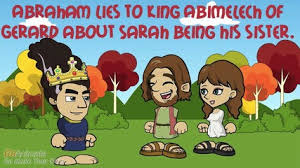
In February 2017, I blogged about Abraham and Sarah’s Bonnie-and-Clyde days.  Long story shorter, when there was a famine (recession) Abraham and Sarah would move somewhere like Egypt or Gerar of the Philistines, pretend they were only brother and sister, and defraud the local king (Genesis 12; 20). 

Isaac was 75 when his father, Abraham, died (Genesis 21:5; 25:8).  The twins, Esau and Jacob, were 15 (Genesis 25:26).  That’s 15-75 years of advice and stories and family history, meaning  Isaac had heard about his parents’ criminal past.   He told his sons, too; and they passed the stories down until they were written into the book of Genesis.   


When famine struck in Isaac’s time, he thought about what his dad had done and moved his family to Gerar of the Philistines --- just like Abraham.  He considered sliding down to Egypt as well, but the Lord appeared to him and said: “Do not go down to Egypt”(Genesis 26:2).

Isaac repeated his father’s journey.  God repeated the promises to Isaac that He’d made to Abraham (Genesis 26:3-4).  And, when Philistine men started checking out Rebekah, big papa Isaac got scared the local guys would kill him and take his wife so he and his wife repeated the family lie.


(Can we just take a moment and reflect on what a crazy world they lived in?  Polygamy was totally acceptable.  So, apparently, was murdering immigrant men with pretty wives.  You could buy or kidnap a man’s sister and force her to be your wife, but you couldn’t touch a guy’s wife while he was
still alive ---- cause that would be wrong.  Of course if you made her a widow by murder, then you were totally clear for the kidnapping and marriage-rape.  Cultural frickin’ norms.)

Isaac and Rebekah weren’t as slick as the previous generation so they got caught.  Abimelech (named for the ancestor who’d dealt with Abraham), king of the Philistines saw Isaac and Rebekah making out.  He called Isaac and said, “Quite obviously she is your wife” (Genesis 26:8,9). 

Isaac and Rebekah were WRONG. 


They broke covenant.  Not THE covenant, another one.

Abimelech said to Abraham, “Now therefore, swear to me by God that you will not deal falsely with me, with my offspring, or with my posterity; but that according to the kindness that I have done to you, you will do to me and to the land in which you have dwelt”

And Abraham said, “I will swear.” (Genesis 21:23, 24).

If Isaac knew the story of Abraham deceiving the older Abimelech, he also knew that Abraham and Abimelech had a solemn, multi-generational covenant under which he should have gone to Abimelech and told him the truth.  Abimelech honored their fathers’ treaty. In fact, the King of the Philistines was angry that Isaac had put him in danger of accidentally breaking his family’s word. 

Abimelech said, “What is this you have done to us? One of the people might soon have lain with your wife, and you would have brought guilt on us.” So Abimelech charged all his people, saying, “He who touches this man or his wife shall surely be put to death.” (Genesis 26:10-11).

This Abimelech wanted no part in the part of the story where the king is rendered infertile and God threatens to kill him. 

In this case, the pre-Israelite Philistine acted honestly and honorably.  The ancestor of Jesus was a liar and a cheater and at least a little bit of a coward. 

It was all daddies’ fault.  (spelling intentional)

When Abimelech #1 told the story to his son and grandson from the Philistine perspective, the message was:  don’t mess with a man’s wife even accidentally because the man’s god will get you.   Even if you ALMOST commit adultery, apologize, give the husband gifts, and make it right with his god.

When Abraham told the story the message was:  this is how I got rich getting over on people.

But when dad tells the story like his sin was a good thing, there’s a strong chance (not a certainty) that his son will make the same poor choices that daddy made like Isaac did when he lied about Rebekah being his wife and when he and Rebekah played their children against each other the way Sarah and Abraham made Ishmael and Isaac into opponents.

Abimelech despite being a religious pagan, learned repentance from his forefather.  Isaac, despite being a pre-Mosaic Jew, learned how to lie just like his daddy. 

Our children will either learn to repent of our sins or they will learn to repeat our sins.  


When we pass to our children a spirit of repetition instead of repentance, we are assigning an inheritance of sin, and God complies by visiting the iniquity of the fathers upon the children and the children’s children to the third and the fourth generation of those who hate Me (Deuteronomy 5:9).
 
Abraham lied.  Isaac lied.  Jacob lied.  Abraham’s sons were rivals.  Isaac’s sons were rivals.  Jacob’s sons sold their brother Joseph into slavery and faked his death.  To the third and fourth generation of those who act hatefully toward God by refusing to repent.


 But if we own (confess) our poor choices and teach the next generation to do better, we break the cycle of generational sin which is the root of generational curses. 


If, however, he begets a son who sees all the sins which his father has done, and considers but does not do likewise;  . .  . who has withdrawn his hand from the poor and not received usury or increase, but has executed My judgments and walked in My statutes, he shall not die for the iniquity of his father.  He shall surely live (Ezekiel 18:14, 17)!

It’s a hard thing to confess your imperfections to the only people who think you’re perfect.  Find the strength.  Deliver them from the sins that so easily beset you.  Break the cycle before they repeat the cycle. 

---Anderson T. Graves II   is a writer, community organizer and consultant for education, ministry, and rural leadership development.

Rev. Anderson T. Graves II is pastor of Miles Chapel CME Church in Fairfield, Alabama;  executive director of the Substance Abuse Youth Networking Organization (SAYNO);  and director of rural leadership development for the National Institute for Human Development (NIHD).

Subscribe to my personal blog  www.andersontgraves.blogspot.com .

Email atgravestwo2@aol.com
Follow me on twitter @AndersonTGraves 

Click here to support this ministry with a donation.  Or go to andersontgraves.blogspot.com and click on the DONATE button on the right-hand sidebar.

Support by check or money order may be mailed to 
Miles Chapel CME Church
P O Box 132
Fairfield, Al 35064


Tuesday, July 11, 2017

FAVOR IS UNFAIR (Genesis 21:22-34)


 22 And it came to pass at that time that Abimelech and Phichol, the commander of his army, spoke to Abraham, saying, “God is with you in all that you do.
23 Now therefore, swear to me by God that you will not deal falsely with me, with my offspring, or with my posterity; but that according to the kindness that I have done to you, you will do to me and to the land in which you have dwelt.”
24 And Abraham said, “I will swear.”
25 Then Abraham rebuked Abimelech because of a well of water which Abimelech’s servants had seized.
. . .
31 Therefore he called that place Beersheba, because the two of them swore an oath there.
32 Thus they made a covenant at Beersheba. So Abimelech rose with Phichol, the commander of his army, and they returned to the land of the Philistines.
 33 Then Abraham planted a tamarisk tree in Beersheba, and there called on the name of the Lord, the Everlasting God.
34 And Abraham stayed in the land of the Philistines many days.  (Genesis 21: 22 - 34)

And it came to pass at that time. . .

The timing is important.  From Genesis 20 we know that Abraham and his people had been camping in Philistine territory since before Isaac was born.  From Genesis 21:8, we know that Isaac is 2 or 3 years old.  Understanding the timing tells us that  Abraham and his people had been living in peace with Abimelech and the Philistines for at least 3 years.

For more than 3 years,  the Philistines had watched Abraham and heard the stories about him.  This Abraham was an old man and a foreigner with no country and no extended family, but he prospered under impossible circumstances.   This guy had  beaten 4 armies at once with only 318 men (Genesis 14), witnessed the destruction of Sodom and Gomorrah  (Genesis 19:27, 28), and  conned the kings of Egypt and  Philistia without being executed or even fined.  In fact, this Abraham guy had been given honors by the kings AFTER they found him guilty of tricking them (Genesis 12; 20). 

And then, at that time,  word got around that 100 year old Abraham and his 90 year old wife Sarah had conceived, successfully birthed, and the son had survived into toddlerhood (which wasn’t a given in those times).  Abraham must have a secret: some supernatural edge that gave him a ridiculously unfair advantage over every one and everything that ran up on him.

Abimelech understood that the secret of Abraham’s success was his God.


And it came to pass at that time that Abimelech and Phichol, the commander of his army, spoke to Abraham, saying, “God is with you in all that you do.

Notice that the Philistine commanders-in-chief went to Abraham.  Abraham didn’t go to them. And they begged Abraham for assurances that he wouldn’t attack. 

 Now therefore, swear to me by God that you will not deal falsely with me, with my offspring, or with my posterity; but that according to the kindness that I have done to you,
 you will do to me and to the land in which you have dwelt.” (Genesis 21:23)

And Abraham said, “I will swear.” (Genesis 21: 24)

When Abraham complained about a disputed well, the king of the Philistines became defensive and apologetic.   

 And Abimelech said, “I do not know who has done this thing; you did not tell me, nor had I heard of it until today.” (Genesis 21: 25-26)

They let Abraham impose an amendment to their treaty under which the nation of Philistia surrendered the disputed water rights to Abraham (Genesis 21: 27 - 31).

Clearly, Abraham had the superior negotiating position.  But that doesn’t make sense.  I mean, Abraham was a rich sheik with a small personal army, but he was sheik of a small nomadic clan camping on borrowed land surrounded by Philistine cities and armies.  Yet, Abraham so consistently came out on top in every encounter that King Abimelech made the strategic decision to sign a treaty lopsided in Abraham’s favor.

Why?

Because God was with Abraham in all that he did (Genesis 21:22).  Because messing with Abraham meant messing with Abraham’s God.  Because, what’s the word we use?   Oh yeah.

Because FAVOR.

“Not by might nor by power, but by My Spirit,” says the Lord of hosts. (Zechariah 4:6)


In the church we talk a lot about favor in the first person. 

“The favor of God is upon ME.” 
“I’M blessed and highly favored.”

Abimelech recognized God’s favor on Abraham’s life.  Do you acknowledge God’s favor when it’s not about you?  Are you happy for your brothers and sisters when they get good that they don’t deserve?  I don’t mean jump on the bandwagon with financially profitable sin.  I mean ask the question “Why did God bless them?” but not rhetorically.  Ask and listen, observe, learn the actual answer.   

Abraham wasn’t perfect.  In some scenarios he was a genuine jerk, but he was the jerk God had chosen to fulfill an important role in the divine plan. God’s favor nudged Abraham back on the path when he strayed.  God’s favor protected him when danger threatened his role in God’s plan.  God’s favor provided what Abraham needed to pass to the descendants who would carry out the next phase of God’s plan.  And the favor on Abraham rewarded righteous people, like Hagar and Ishmael, who got caught in the orbit of God’s main plan for Abraham.

Favor didn’t put Ishmael in the messianic line despite Abraham’s request.   In the book of Jonah, favor sent a storm and a giant fish to “help” Jonah find his way to Nineveh.  Favor blinded Saul on the Damascus road so he could become the missionary and prolific author of Scripture God intended.  None of those blessed and highly favored men asked for the path God imposed upon them. 

But favor isn’t fair.  Not even to the favored. 

The favor of God isn’t about the person; it’s really about the plan:  God’s plan.

So you don’t need to jump on anybody’s bandwagon or kiss anybody’s butt to benefit from the favor of God in THEIR life.  You just have to understand their role in God’s plan and then find your place in or around that plan. 

Favor isn’t about the person; it’s about the plan:  God’s plan.

When you experience favor, remember what it’s for and remember Whom it’s from.

You’re good, but you’re not THAT good.  God did it.  You’re smart but --- be honest --- you weren’t smart enough to see that coming.  God revealed it to you.  People like you, but seriously, not THAT much.  Your opportunities, your second and third plus chances aren’t your doing. 

God is the secret to your success. 

After the phenomenally successful meeting with the Philistines,  Abraham planted a tamarisk tree in Beersheba, and there called on the name of the Lord, the Everlasting God (Genesis 21:33).  Abraham gave praise to God and planted a reminder that his favored position in Philistine territory was because of God.

When that meeting goes waaaay better than it should have, don’t forget to have a praise party when everyone else has left ---- maybe even before.  When you’re in that new office, new home, new position, better situation, plant something there: a plant, a plaque, a screensaver, a symbol that you pass every day to remind you that life isn’t fair; but God has made it unfair in your FAVOR.


---Anderson T. Graves II   is a writer, community organizer and consultant for education, ministry, and rural leadership development.

Rev. Anderson T. Graves II is pastor of Miles Chapel CME Church in Fairfield, Alabama;  executive director of the Substance Abuse Youth Networking Organization (SAYNO);  and director of rural leadership development for the National Institute for Human Development (NIHD).

Subscribe to my personal blog  www.andersontgraves.blogspot.com .

Email atgravestwo2@aol.com
Follow me on twitter @AndersonTGraves 

Click here to support this ministry with a donation.  Or go to andersontgraves.blogspot.com and click on the DONATE button on the right-hand sidebar.

Support by check or money order may be mailed to 
Miles Chapel CME Church
P O Box 132
Fairfield, Al 35064


Friday, June 16, 2017

IT'S COMPLICATED (Genesis 20)

Genesis 20.


It easy with cartoons.  The heroes are good guys who only do good things, and the villains are bad guys who only do bad things.   Reality is more complicated.  Sometimes the “hero” does something bad, something absolutely and deliberately morally wrong when he had the option to do good but he just didn’t.  Sometimes the “villain” is more ethical and honorable than the hero.  In the real world, people are complicated.

Unfortunately, we tend to read the Bible like it isn’t about the real world.  We oversimplify the actions and character of Biblical figures so that they neatly fit into our images of good guys and bad guys.  That may be how we read Scripture, but that isn’t how it’s written.  The Bible speaks reality, and reality ---- is complicated.


For example, Genesis 20 is a story of lies, enticements to sexual sin, and fraud at the highest levels.  It’s also the story of how God took extreme steps to preserve the integrity of an honorable king.

The main figures in Genesis 20 are Abraham, Sarah, and Abimelech.  Abraham and Sarah were the ancestors of the promised line of the Jews out of which would come Moses, and David, the prophets, and Jesus.  Obviously, they’re the heroes.  Abimelech was the pagan king of the early Philistines, a founding father of Goliath’s homeland; he’s the obvious villain.

But.  (If you’ve been following my blog, you had to know there was a but.)

But all the crimes and sins in Genesis 20 were committed by Abraham and Sarah, and the only ethically correct person was the biggest Philistine in the country.  Cause when you tell the truth, the whole truth about the real world ---- it’s complicated.

See what had happened was: Abraham moved his family into the territory of the Philistine city-state Gerar. There, Abraham and Sarah reverted to an old con-game they’d been playing for decades.  Sarah pretended to be Abraham’s sister and not his wife.  Which was half-true but totally a lie.  It’s complicated. (Read the post Crime Doesn’t Pay but it Does Collect Interest to learn more about Abraham’s and Sarah’s crime spree.)  


Sarah was pushing 90, but she was still an extraordinarily beautiful woman, so Abimelech did what kings did in those time ----- he took the beautiful woman to be his wife with, I must add, the full permission of the male head of her household, her older “brother” Abraham the Hebrew. 

But Abimelech never consummated the marriage.  He couldn’t.

Let me explain. 

While Sarah was in Abimelech’s home, the house of Abimelech experienced 100% infertility.    Prior to the advent of modern medical knowledge of the reproductive process, infertility was attributed to women.  e.g., the Lord had closed up all the wombs of the house of Abimelech (Genesis 20:18); but, verse 17 says that the plague of infertility ended when God healed the women in Abimelech’s harem and when God healed Abimelech himself. 

In a dream, God told the king of the Philistines that I also withheld you from sinning against Me; therefore I did not let you touch her (verse 6).

Now how did God keep Abimelech from touching Sarah?  Why did Abimelech need healing, too?

O.K., I’m just going to be blunt.  God made it so Abimelech couldn’t get it up. 

But not to punish the king of the pagan city.  To protect his honor, because Abraham and Sarah had tricked Abimelech.  The Philistine hadn’t done anything wrong. As the Lord him, Yes, I know that you did this in the integrity of your heart” (Genesis 20:6).

When God corrected, Abimelech the pagan immediately took Sarah back to Abraham and made things right.   Now, think about all the times that Abraham and Sarah didn’t stick to God’s plan.  If you need help, remember that Hagar and Ishmael were in Abraham’s camp watching the whole lying scene.

Abraham had lied to his host, deceived the government of the nation of his residency, caused a plague, and basically pimped out his wife.  But, his reasons kinda made sense.  Abraham has a large, rich household including thousands of livestock and  hundreds of armed men (Genesis 14:14).  It was reasonable to worry that the Philistines might take the presence of a beautiful woman as an excuse to kill Abraham’s people and take his stuff, or they might take the offer of a beautiful woman as the perfect offering of peace.  He couldn’t give them Hagar because there was the son who looked like both of them.  For the good of the entire household, Abraham and Sarah agreed to leave Sarah vulnerable to the men of Philistia.  Or out of cowardice.  Or out of faith that God would protect her somehow because God had promised them a child together.  Or some combination of all the above.

It was complicated.

Abimelech wholeheartedly believed in the existence and power of God (Yahweh/Jehovah).  He talked with God, and the Lord regarded him as a man of integrity, a “good” man.  Abimelech pursued righteousness (verse 9) and exercised mercy.  Instead of imprisoning, enslaving, torturing, and or executing Abraham, Sarah, and everyone they knew and loved, Abimelech paid a self-imposed fine for keeping Sarah away from her husband (verse 16), showered Abraham with other gifts, and gave them permanent access to the pastures and campgrounds of Philistia.  Because Abimelech recognized that Abraham was a prophet.  And because Abraham’s God was  a supernatural weapon of mass destruction Who could penetrate Gerar’s security apparatus and infect Abimelech’s people with the biological agent of His choice.  So, Abraham wouldn’t be punished for his crimes.  He would be rewarded.  The king perverted justice, but only because it was in his people’s national interest.   


It was complicated. 

God scared the Philistines, but He didn’t do them any lasting harm.  No one died, and their populations soon resumed it’s natural progression.   While population growth was at zero, the Lord gave Abraham and time to repent and come clean.  When they didn’t God used the good villain to reunite the family of the lying heroes ---- not because Abraham and Sarah deserved the promises God had made, but because God had made them.

God had given Abraham His Word that he and Sarah would have a son.  The word wasn’t that Sarah and Abimelech would have a son.
 
So shall My word be that goes forth from My mouth; It shall not return to Me void, But it shall accomplish what I please, And it shall prosper in the thing for which I sent it (Isaiah 55:11).

The complications people create are undependable.  God is complicated, but He is consistent.  That’s why we can trust the Lord. 

For I am the Lord, I do not change; Therefore you are not consumed, O sons of Jacob. (Malachi 3:6)


The Bible is deep, complex, life-directing, and God-affirming.  If we would accept the complexity of its truth, Christian scholars wouldn’t have to make so many excuses.  You don’t have to manufacture arguments against God’s judgment to have faith in God’s love.  You don’t have to censor verses and chapters to construct a narrative that satisfies a selfish, simple taste for one dimensional characterizations.  You don’t have to embrace atheism or ignore contradictory actions and statements.  Those contradictions aren’t errors or clues to a 3rd century editorial conspiracy.  Those so-called contradictions are evidence that the Bible is the truth and nothing but the truth. 

Because when you tell the truth about human beings, it’s always complicated. 

But when God is part of the story, even the complications make sense.  


---Anderson T. Graves II   is a writer, community organizer and consultant for education, ministry, and rural leadership development.

Rev. Anderson T. Graves II is pastor of Miles Chapel CME Church in Fairfield, Alabama;  executive director of the Substance Abuse Youth Networking Organization (SAYNO);  and director of rural leadership development for the National Institute for Human Development (NIHD).

Subscribe to my personal blog  www.andersontgraves.blogspot.com .

Email atgravestwo2@aol.com
Follow me on twitter @AndersonTGraves 

Click here to support this ministry with a donation.  Or go to andersontgraves.blogspot.com and click on the DONATE button on the right-hand sidebar.

Support by check or money order may be mailed to 
Miles Chapel CME Church
P O Box 132
Fairfield, Al 35064