Search This Blog

Showing posts with label depression. Show all posts

Saturday, October 31, 2020

MISERY LOVES COMPANY?


They say, “Misery loves company,” but I don’t know about that. 

The idea is we tend to spread our pain to others as if by division we can diminish our share of anguish.  I’ve been sad enough to be bitter and make my company miserable, too.  It didn’t help.  For each companion infected with despair, the inverse occurred, and my share of misery multiplied.   My misery does not love present company. 

But PAST company is welcome. 

There is surprising comfort in realizing that my particular distress isn’t particular to me.  Someone else has scars in the same place.  Others have fought the same battle, lost it like me, survived the loss, fought it again, and survived to share the story.

 This is why I love the Bible’s record of failures.  

 Jacob “wrestling” with insomnia because he’s convinced himself that his brother is going to massacre his entire family (Genesis 32).  David starving himself in seemingly suicidal desperation because he can’t fix the consequences his stupid choices have caused for his child (2 Samuel 12).  Elijah in a state of bi-polar depression running away from his greatest success, isolating himself from loyal company, mentally self-abusing, and wanting to just die. “It is enough! Now, Lord, take my life, for I am no better than my fathers!” (1 Kings 19: 4).  

None of those miserable examples of humanity survived that moment unscathed, but each of them survived.  They got up --- limping, grieving, chastised and still angry; but they got up and went on to succeed.   

 It comforts me to be in the company of such a great cloud of miserable witnesses.  

It should comfort our community to open the Bible and read that that we are not  the first community of faith to experience this particular combination of anxiety, anger, hope?, resignation, and cynicism about the possibilities of justice. 

The Korahites had been slaves, leaders, rebels, outcasts, and worship leaders.   One of their songs declares the misery of being citizens of a country defined by sin, led by lies, governed unjustly, and oppressed with impunity. 


Vindicate me, O God,

And plead my cause against an ungodly nation;

Oh, deliver me from the deceitful and unjust man!

For You are the God of my strength;

Why do You cast me off?

Why do I go mourning because of the oppression of the enemy?  (Psalm 43: 1-2)


The sons of Korah pleaded for a sign, for a Word from the Lord that would make all their praise and worship seem relevant in the midst of national misery.

 Oh, send out Your light and Your truth!

Let them lead me;

Let them bring me to Your holy hill

And to Your tabernacle.

Then I will go to the altar of God,

To God my exceeding joy;

And on the harp I will praise You,

O God, my God. (Psalm 43: 3-4)

We don’t know what were the specific issues which inspired the 43rd psalm. What were the alternative facts delivered by the deceitful and unjust man?  Whose lives didn’t matter to the ungodly nation they nevertheless loved?  What were the systemic tools used for oppression?  We don’t know how or if the complaints in the psalm were justly resolved? 


All we know is their misery. 


And we know how they survived, got up, and kept going. 

 Why are you cast down, O my soul?

And why are you disquieted within me?

Hope in God;

For I shall yet praise Him,

The help of my countenance and my God. (Psalm 43:  5)     


The Korahites worked on themselves internally. 

Why are you cast down, O my soul?  And why are you disquieted within me? 

They concluded that they could not survive depending on circumstances as the source of their mental health.  They recalled that they, like the miserable saints before could endure and progress if they placed their hope in God. 

Hope in God 

The Sons of Korah decided to reinvest in their praise and worship.  To simply DECIDE that their praise and worship was relevant. 

For I shall yet praise Him


They decided to remember, to believe, to KNOW that God had brought them through every past battle; and, therefore, He would bring them through the next battles, including the battles with their own misery. 

The help of my countenance and my God.  

 These all foreshadowed the greatest story of misery and success. 

JESUS had no form or comeliness . . . no beauty that we should desire Him. . .  He was despised and rejected by men, a Man of sorrows and acquainted with grief.  He was lonely because we hid, as it were, our faces from Him.  He was despised, and we did not esteem Him.   (Isaiah 53: 2, 3)


Jesus triumphed over death, the grave, Hell, sin, and human betrayal.  This is our God in whose eternal company we have our most precious hope. 

This is the company that misery can love.   

Over and over, the Bible affirms:  You may not feel alright right now, but you will be alright in the long run. 

You will lose sometimes, but you will ultimately win.

God’s people hurt, too.  But God heals His people.   Every time.

May our present anxiety find relief in the great cloud of witnesses who have suffered and triumphed before us.       

 AND GO VOTE ON TUESDAY. 

-  Anderson T. Graves II, is a writer, community organizer, consultant and the pastor of Bailey Tabernacle CME Church 

Email: BaileyTabernacleChurch@comcast.net

Friend on Facebook at www.facebook.com/rev.a.t.graves

Follow on twitter @AndersonTGraves 

Support this blog with a donation to paypal.me/andersongraves  or CashApp  at $atgraves or on the DONATE button on the right-hand sidebar. 


Sunday, May 21, 2017

MORE LIGHT; LESS SHADE

You know what “throwing shade” is, right? 

It’s when someone indirectly or passive aggressively questions the worth of someone’s actions, decisions, or presence.  Some people make throwing shade a hobby, even a profession, but what can you do when the shade is so heavy that you no longer see the light?  The answer is found in the Beatitudes of Matthew chapter 5. 

The title of the message is MORE LIGHT; LESS SHADE.

Please comment.


Listen well.

If you can’t get the audio on your device, visit the main podcast page at http://revandersongraves.podomatic.com/

---Anderson T. Graves II   is a writer, community organizer and consultant for education, ministry, and rural leadership development.

Rev. Anderson T. Graves II is pastor of Miles Chapel CME Church in Fairfield, Alabama;  executive director of the Substance Abuse Youth Networking Organization (SAYNO);  and director of rural leadership development for the National Institute for Human Development (NIHD).

Subscribe to my personal blog  www.andersontgraves.blogspot.com .

Email atgravestwo2@aol.com
Follow me on twitter @AndersonTGraves  #Awordtothewise 

You can help support this ministry with a donation.  Just click on the DONATE button on the right-hand sidebar.

Support by check or money order may be mailed to 
Miles Chapel CME Church
P O Box 132
Fairfield, Al 35064

Monday, August 3, 2015

JOHN THE BAPTIST, JOHN THE DOUBTER


(This post is an expansion on a sermon I preached.  Read the blog and then listen to the sermon "It All Makes Sense with Jesus." )

In Matthew 11, Jesus called John the Baptist the greatest of all prophets. 

“Yes, I say to you, and more than a prophet. Assuredly, I say to you, among those born of women there has not risen one greater than John the Baptist” (Matthew 11: 9,11)

We honor John the Baptist as the epitome of uncompromising spiritual strength.  We have canonized his legend and forgotten his truth:  John’s spiritually victorious life was also a life of agonizing DOUBT.

Read his story again.

So the child grew and became strong in spirit, and was in the deserts till the day of his manifestation to Israel. (Luke 1:80)

In the deserts, apparently from a very young age.  His parents had a house in the hills southern Judea.  They had connections in the Temple in Jerusalem.  Why was John in the desert?

Because he ran away.  Not to adventures in the great metropolis of Jerusalem.  Not to the freedom of the semi-pagan Decapolis, or to the outlaw lands of Galilee.  No.  John ran to the most desolate and lonely spaces his nation offered.  He fled----- from everything.

Now John himself was clothed in camel’s hair, with a leather belt around his waist… (Matthew 3: 4a)

You know those kids at your school who dress like hobos even though their parents are rich?  You know the ones who blacken their eyes and refuse to condition their hair, and carefully choose the least physically flattering clothing they can find.   John the Baptist would have been one of them. 

…his food was locusts and wild honey. (Matthew 3:4b)

You know that kid who starves himself at lunch and on field trips because he’s such a strict kind of vegan that other vegans think he’s crazy?   That kid’s got nothing on John the Baptist. 

From before he was even conceived, John the Baptist’s life was clearly defined.  The purpose of his existence was predetermined.  We glamorize being “The Promised Child,”  “The Chosen One.”   But think about how suffocating that was.  John was an adolescent who never had the chance to find himself.  There was no seeking, no just being.  John’s future never held the mystery of what he might become.  He was always “the prophet of the Highest [who] will go before the face of the Lord to prepare His ways” (Luke 1:76).  And if he screwed up, Israel’s Messiah might never appear.  That was John’s bedtime story.  

“You’re not the Messiah.  You can’t save your people.  But you can single-handedly destroy 5,000 years of prophetic hope.  Nighty-night.”

No wonder John defined himself in negatives.

John was not the Temple priest his father Zacharias was.  He was not the well-pedigreed heir of religious royalty that his mother was. 

The Jews sent priests and Levites from Jerusalem to ask him, “Who are you?”
He confessed, and did not deny, but confessed, “I am not the Christ.
And they asked him, “What then? Are you Elijah?”
He said, “I am not.”
“Are you the Prophet?”
And he answered, “No.” (John 1: 19-22)

When asked, “What do you say about yourself?” John replied, “I am The voice of one crying in the wilderness,  ‘Make straight the way of the Lord,’ as the prophet Isaiah said.”  (John 1: 22, 23)

Do you hear the sadness?   I’m not a body.  I’m not a person.  I’m just a voice.  And not even my own voice.

But John still followed his calling.  He preached the words God put in his heart.  He baptized sinners and hypocrites.  The man who’d fled from the world endured fame.  Read the exchange in Luke 3: 7-18.  No matter how raw and roughly John preached, the people just kept coming.  No matter how far up or down the Jordan he camped, people found him. And John didn’t like people.

John’s only solace was the promise of the Messiah.  When the Messiah appeared, John would announce Him, fulfill the burden of his birth and finally, finally find peace.  From a child, from a fetus John knew that the Messiah was his cousin.  His mother knew that the Christ was only 6 months younger than John.  His family knew Jesus’ family but John and Jesus didn’t meet--- for 30 years.

Thir-tee. Yeeeaaarrrrs.

John didn’t even know what Jesus looked like.

I did not know Him; but that He should be revealed to Israel, therefore I came baptizing with water. (John 1: 31)

But John still followed his calling.  He preached the words God gave him.  He baptized.    Before Jesus spoke the Great Commission to His apostles, John fulfilled the Great Commission by the Holy Spirit.  And then the moment came.

After a long day of ministering to the same kinds of soul-wearying crowds, one last person came down to be baptized (Luke 3: 21).   It was Jesus, and finally John’s life made sense. 

John recalled, “I did not know Him, but He who sent me to baptize with water said to me, ‘Upon whom you see the Spirit descending, and remaining on Him, this is He who baptizes with the Holy Spirit.’ And I have seen and testified that this is the Son of God.” (John 1: 33, 34)

John could fulfill his mission.  He could do what he was born to do.  He baptized the Messiah, and “immediately the Spirit drove Him into the wilderness.” (Mark 1: 12)

Wait.  What da’ crap?!  Where did Jesus go?

For a month and a half (well, for at least 40 days), nobody knew where Jesus was.  John had finally found the cousin whose life defined his life and now he’d lost him.  

Consider that for a moment.

Your entire sense of value as a person is wrapped in being the one who introduces the Christ to the world, and the moment you can do that, you turn around and Pthht! He was gone.

So when Jesus shows up about a month and a half later, the day after John has told the story of the baptism to his disciples,   “John saw Jesus coming toward him, and said, ‘Behold! The Lamb of God who takes away the sin of the world!’ This is He of whom I said, ‘After me comes a Man who is preferred before me, for He was before me.’ “ (John 1: 29, 30)

This is John happy.  This is John thinking, “Once I direct people to Jesus, I will have fulfilled my destiny.”   So that’s exactly what John does.

The next day, John stood with two of his disciples.    And looking at Jesus as He walked, he said, “Behold the Lamb of God!”
The two disciples heard him speak, and they followed Jesus.  (John 1: 35-37)

Messiah found?  Check.
Messiah proclaimed? Check.
People sent to follow the Messiah?  Check.
Ahh.  I did it.  Now I can find peace.

Nope. 

Now you can get thrown in prison on some old trumped-up charge about criticizing the government. (Mark 6: 17-18)

In prison, John’s old doubts came back.   Maybe he’d been wrong.  Maybe it was wishful thinking.  Maybe Jesus wasn’t the One.   

When John had heard in prison about the works of Christ, he sent two of his disciples and said to Him, “Are You the Coming One, or do we look for another?”  (Matthew 11: 2-3)

Notice that John never doubted the idea of the Messiah.  He just wanted reassurance that he’d picked the right Messiah. John didn’t doubt God’s promise.  He didn’t doubt his calling. John doubted his competence in carrying out the divine assignment.

From childhood to shortly before his death, John the Baptist doubted himself.

In a media-verse of T.D. Jakeses and Benny Hinns, Joel Osteens, and Bishop-Apostle-Doctor-Overseer-Megapastors, people forget that many “might men of God” are, like John the Baptist, life-long doubters of self.

Moses, Elijah, Isaiah, Jeremiah, Amos, etc., etc. We don’t doubt the reality of God.  We don’t doubt the Lord’s power or His plan.  We absolutely, to the point of death and beyond, believe what we preach.  But we don’t believe in ourselves. 

We’re always pretty sure that today’s the day we totally screw up the whole thing.

You see, John the Baptist’s story isn’t important because his public ministry was unique.  John’s story is important because his internal struggle is typical.

But his triumph is typical, too.

John the Baptist saw himself as a series of negatives: not the Christ, not the Prophet (Deuteronomy 18: 15-18), and not Elijah.

John was wrong.

Jesus said, “If you are willing to receive it, he is Elijah who is to come.” (Matthew 11: 14)

John was much of what he thought he wasn’t. 

When we are called and we doubt but we follow our calling anyway, God makes us more than we are able to accept that we can be.  Many of us will die without ever acknowledging to ourselves who we really are in God’s eyes.  That’s just the way it is.  That’s the way it’s been for a long time.

Just ask Jesus’ cousin, John the Baptist.

---Anderson T. Graves II   is a writer, community organizer and consultant for education, ministry, and rural leadership development.

Rev. Anderson T. Graves II is pastor of Miles Chapel CME Church in Fairfield, Alabama;  executive director of the Substance Abuse Youth Networking Organization (SAYNO);  and director of rural leadership development for the National Institute for Human Development (NIHD).

Subscribe to my personal blog  www.andersontgraves.blogspot.com .

Email atgravestwo2@aol.com
Follow me on twitter @AndersonTGraves 
#Awordtothewise

You can help support this ministry with a donation to Miles Chapel CME Church.

You can help support Rev. Graves’ work by visiting his personal blog and clicking the DONATE button on the right-hand sidebar.

Support by check or money order may be mailed to 
Miles Chapel CME Church
P O Box 132

Fairfield, Al 35064

Monday, February 16, 2015

THE BIPOLAR PROPHET


In the final chapter of his epistle, the author of the book of James talked about the power of  prayer.   

The effective, fervent prayer of a righteous man avails much.  (James 5: 16)

For the righteous man who best exemplified effective and fervent prayer, James chose the Old Testament prophet Elijah.  But, James’ description of Elijah didn’t concentrate on Elijah’s effectiveness, his fervency, or his righteousness.   The focus was on Elijah’s ISSUES.

Elijah was a man with a nature like ours, and he prayed earnestly that it would not rain; and it did not rain on the land for three years and six months. And he prayed again, and the heaven gave rain, and the earth produced its fruit. (James 5: 16-18)

Like all of us, the Elijah had issues.  Elijah’s specific issue was that the prophet was bipolar.

The Mayo Clinic website provides the following definition:
Bipolar disorder, formerly called manic depression, causes extreme mood swings that include emotional highs (mania or hypomania) and lows (depression). When you become depressed, you may feel sad or hopeless and lose interest or pleasure in most activities. When your mood shifts in the other direction, you may feel euphoric and full of energy. Mood shifts may occur only a few times a year or as often as several times a week.

Now read back through  1 Kings 18.

Elijah got all up in King Ahab’s face and said, “I’m not the one causing trouble in Israel. YOU’RE the one causing trouble in Israel!  YOU. YOUR WIFE. YO’ MAMA. AND EVERYBODY IN YO’ HOUSE!” (1 Kings 18: 16-18, “slightly” paraphrased)

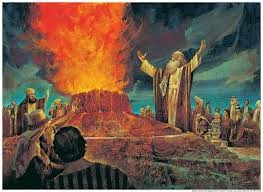
In verses 19-24,  Elijah challenged 850 pagan prophets to a winner-take-all pray-off in front of the whole country.

Elijah prayed down fire from Heaven.

He incited a violent uprising against the pagan priests favored by King Ahab and Queen Jezebel. (verses 36-40)


Afterwards, Elijah told the king, “Bro, you better grab a snack cause I’m bout ta’ bring the rain.” (verse 41, paraphrased)

And then, after giving Ahab’s royal chariot a head start, Elijah outran the chariot--- on foot!

So he said, “Go up, say to Ahab, ‘Prepare your chariot, and go down before the rain stops you.’ ” … Then the hand of the Lord came upon Elijah; and he girded up his loins and ran ahead of Ahab to the entrance of Jezreel.  (1 Kings 18: 44-46)

That’s about 30 miles by Route 66 in Israel.  On foot!

Wow! Just wow!  1 Kings 18 was the greatest emotional high of Elijah’s prophetic career.

And the opening verses of the next chapter, immediately after all of this, is Elijah running away, all the way out of the country, dropping off his assistant, and going off into the woods to sit under a tree and think suicidal thoughts.  (1 Kings 19: 3-4)

Elijah’s suicidal depression was triggered when Queen Jezebel threatened his life (verses 1-2)--- which, given Jezebel’s well-established record of systematically killing off all the Jewish prophets she could find, shouldn’t have been a shock to Elijah, especially after Elijah had 400 of her favorite pagans killed.

Elijah’s feelings were not rationally proportionate to the situation.  But, depression isn’t proportionate or rational. Depression is all-consuming.

By fleeing to Judah and then leaving his servant in Beersheba, Elijah isolated himself.

An angel made Elijah get up and eat only to come back the and find him again still curled up alone and not eating. (verses 5-7)

Even, after 40 days, when Elijah had made his way to Mt. Horeb, the mountain of the Lord, where God was going to speak to him, the prophet was still in a deep, dark emotional place.

Twice, God asked Elijah, “What are you doing?”

Twice Elijah, gave the same pitiful answer:
“I have been very zealous for the Lord God of hosts; for the children of Israel have forsaken Your covenant, torn down Your altars, and killed Your prophets with the sword. I alone am left; and they seek to take my life.” (1 Kings 19: 10)

From hyper, chariot-racing, rain-bringing, fire-starting champion, to suicidal, emo, repeating-himself basketcase.

Elijah was bipolar.

Point?

1)      Mental illness is not a sin.  Elijah was bipolar, but he was also the New Testament example of a righteous man whose prayers God heard and answered.

2)      Your “issues” don’t have to keep you away from God.  Elijah prayed while he was suicidal, and God answered. 

3)      The absence of an immediate answer doesn’t mean the absence of an answer.  Elijah was out in the wilderness, under trees, and in caves for over 40 days before God spoke to him in the still small voice that showed the way out.

4)      Your issues don’t change your calling.  After 1 Kings 18 & 19, Elijah was still bipolar, and he was still the great prophet of Israel.  The Lord sent Elijah back to do the exact same work he had run away from.

The LORD said to him, "Go back the way you came. (1 Kings 19: 15, NIV)

Dealing with your mental issues will make your ministry even stronger.  After this episode, Elijah went on to anoint two kings (different countries) and his own successor, whom Elijah personally trained and left with a double portion of spiritual power. (2 Kings 2)

5)      Your “anointing” doesn’t fix your mental illness.  I repeat: You may be genuinely called, anointed, and gifted for a great spiritual work; and still need outside help with your mental health issues.


In 1 Kings 19, God sent a mighty whirlwind, a great earthquake, and a consuming fire; but after all those miracles Elijah still had the same depression-driven  answer to the question: What are you doing here? (1 Kings 19: 11-13)

Which brings us to the final point.
6)      If you are a man or woman with issues like Elijah, or any other mental health issue, keep praying mightily for others, but also GET YOURSELF SOME HELP.

The still small voice of God commanded Elijah to stop isolating himself.  God told Elijah to get help from Jehu of Israel, Hazael of Syria, and Elisha of Abel Meholah; and God referred Elijah to the 7,000 member sons of the prophets support group.  (verses 16-18)

Of all the mighty men and women of prayer in the Old Testament, the Holy Spirit told James to write about Elijah.  That wasn’t an accident. 

Learn the lessons of the bipolar prophet. 

This post expands on my notes for the sermon “Plans & Issues.”  Click here to listen to the complete message.

---Anderson T. Graves II   is a writer, community organizer and consultant for education, ministry, and rural leadership development.

Rev. Anderson T. Graves II is pastor of Miles Chapel CME Church in Fairfield, Alabama;  executive director of the Substance Abuse Youth Networking Organization (SAYNO);  and director of rural leadership development for the National Institute for Human Development (NIHD).

Subscribe to my personal blog  www.andersontgraves.blogspot.com .

Email atgravestwo2@aol.com
Follow me on twitter @AndersonTGraves 

You can help support this ministry with a donation to Miles Chapel CME Church.

You can help support Rev. Graves’ work by visiting his personal blog and clicking the DONATE button on the right-hand sidebar.

Support by check or money order may be mailed to 
Miles Chapel CME Church
P O Box 132

Fairfield, Al 35064

Sunday, February 15, 2015

PLANS & ISSUES

God has a plan for each individual’s life.  He also has a plan for the collective life of our culture and people. So then why are conditions in the culture so far from God’s will? The problem isn’t the plan.  The problem is us, specifically our “issues.”

Our issues can destroy a good plan so we have to have a plan for dealing with our issues.  It’ll make sense when you take a new look at the story of Elijah, the bipolar prophet.  The message is called PLANS & ISSUES.


Listen well.

If you can’t get the audio on your device, visit the main podcast page at http://revandersongraves.podomatic.com/

---Anderson T. Graves II   is a writer, community organizer and consultant for education, ministry, and rural leadership development.

Rev. Anderson T. Graves II is pastor of Miles Chapel CME Church in Fairfield, Alabama;  executive director of the Substance Abuse Youth Networking Organization (SAYNO);  and director of rural leadership development for the National Institute for Human Development (NIHD).

Subscribe to my personal blog  www.andersontgraves.blogspot.com .

Email atgravestwo2@aol.com
Follow me on twitter @AndersonTGraves  #Awordtothewise 

You can help support this ministry with a donation to Miles Chapel CME Church.

You can help support Rev. Graves’ work by visiting his personal blog and clicking the DONATE button on the right-hand sidebar.

Support by check or money order may be mailed to 
Miles Chapel CME Church
P O Box 132

Fairfield, Al 35064