
In the final chapter of his epistle, the author of the book of James talked about the power of prayer.
The effective, fervent
prayer of a righteous man avails much. (James 5:
16)
For
the righteous man who best
exemplified effective and fervent prayer, James chose the Old
Testament prophet Elijah. But, James’
description of Elijah didn’t concentrate on Elijah’s effectiveness, his
fervency, or his righteousness. The focus
was on Elijah’s ISSUES.
Elijah was a man with a
nature like ours, and he prayed earnestly that it would not rain; and it
did not rain on the land for three years and six months. And he prayed again,
and the heaven gave rain, and the earth produced its fruit. (James 5: 16-18)
Like
all of us, the Elijah had issues. Elijah’s
specific issue was that the prophet was bipolar.
The
Mayo
Clinic website provides the following definition:
Bipolar
disorder,
formerly called manic depression, causes extreme mood swings that
include emotional highs (mania or hypomania) and lows (depression). When you
become depressed, you may feel sad or hopeless and lose interest or pleasure in
most activities. When your mood shifts in the other direction, you may feel
euphoric and full of energy. Mood shifts may occur only a few times a year or
as often as several times a week.
Now
read back through 1 Kings 18.
Elijah
got all up in King Ahab’s face and said, “I’m not the one causing trouble in
Israel. YOU’RE the one causing trouble in Israel! YOU. YOUR WIFE. YO’ MAMA. AND EVERYBODY IN YO’
HOUSE!” (1
Kings 18: 16-18, “slightly” paraphrased)
In verses
19-24, Elijah challenged 850 pagan
prophets to a winner-take-all pray-off in front of the whole country.

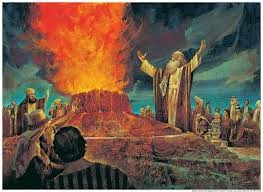
Elijah
prayed down fire from Heaven.
He incited
a violent uprising against the pagan priests favored by King Ahab and Queen
Jezebel. (verses
36-40)
Afterwards,
Elijah told the king, “Bro, you better grab a snack cause I’m bout ta’ bring
the rain.” (verse
41, paraphrased)
And
then, after giving Ahab’s royal chariot a head start, Elijah outran the
chariot--- on foot!
 So he said, “Go up, say to
Ahab, ‘Prepare your chariot, and
go down before the rain stops you.’ ” … Then the hand of the Lord came upon
Elijah; and he girded up his loins and ran ahead of Ahab to the entrance of
Jezreel. (1 Kings 18: 44-46)
So he said, “Go up, say to
Ahab, ‘Prepare your chariot, and
go down before the rain stops you.’ ” … Then the hand of the Lord came upon
Elijah; and he girded up his loins and ran ahead of Ahab to the entrance of
Jezreel. (1 Kings 18: 44-46)
That’s
about 30 miles by Route
66 in Israel. On foot!
Wow!
Just wow! 1 Kings 18 was the greatest
emotional high of Elijah’s prophetic career.
And
the opening verses of the next chapter, immediately after all of this, is Elijah
running away, all the way out of the country, dropping off his assistant, and
going off into the woods to sit under a tree and think suicidal thoughts. (1
Kings 19: 3-4)

Elijah’s
suicidal depression was triggered when Queen Jezebel threatened his life (verses
1-2)--- which, given Jezebel’s well-established record of systematically killing
off all the Jewish prophets she could find, shouldn’t have been a shock to
Elijah, especially after Elijah had 400 of her favorite pagans killed.
Elijah’s
feelings were not rationally proportionate to the situation. But, depression isn’t proportionate or
rational. Depression is all-consuming.
By fleeing
to Judah and then leaving his servant in Beersheba, Elijah isolated himself.
An
angel made Elijah get up and eat only to come back the and find him again still
curled up alone and not eating. (verses
5-7)
Even,
after 40 days, when Elijah had made his way to Mt. Horeb, the mountain of the
Lord, where God was going to speak to him, the prophet was still in a deep,
dark emotional place.
Twice,
God asked Elijah, “What are you doing?”
Twice
Elijah, gave the same pitiful answer:
“I have been very zealous
for the Lord God of hosts; for the children of Israel have forsaken Your
covenant, torn down Your altars, and killed Your prophets with the sword. I
alone am left; and they seek to take my life.” (1 Kings 19: 10)
From
hyper, chariot-racing, rain-bringing, fire-starting champion, to suicidal, emo,
repeating-himself basketcase.
Elijah
was bipolar.
Point?
1) Mental illness is not a sin. Elijah was bipolar, but he was also the New
Testament example of a righteous man
whose prayers God heard and answered.
2) Your “issues” don’t have to keep you away from God. Elijah prayed while he was suicidal, and God
answered.
3) The absence of an immediate answer doesn’t mean the
absence of an answer. Elijah was out in the wilderness,
under trees, and in caves for over 40 days before God spoke to him in the still
small voice that showed the way out.
4) Your issues don’t change your calling. After 1 Kings 18 & 19, Elijah was still
bipolar, and he was still the great prophet of Israel. The Lord sent Elijah back to do the exact
same work he had run away from.
The LORD said to him,
"Go back the way you came. (1 Kings 19: 15, NIV)
Dealing with your mental issues will make your ministry even
stronger. After this episode, Elijah went
on to anoint two kings (different countries) and his own successor, whom Elijah
personally trained and left with a double portion of spiritual power. (2 Kings
2)
5) Your “anointing” doesn’t fix your mental illness. I repeat: You may be genuinely called,
anointed, and gifted for a great spiritual work; and still need outside help
with your mental health issues.

In 1 Kings 19, God sent a mighty whirlwind, a great earthquake, and a
consuming fire; but after all those miracles Elijah still had the same
depression-driven answer to the
question: What are you doing here? (1
Kings 19: 11-13)
Which
brings us to the final point.
6) If you are a man or woman
with issues like Elijah, or any other mental health issue, keep praying
mightily for others, but also GET YOURSELF SOME HELP.
The still small voice of God commanded Elijah to stop isolating
himself. God told Elijah to get help
from Jehu of Israel, Hazael of Syria, and Elisha of Abel Meholah; and God referred
Elijah to the 7,000 member sons of the prophets support group. (verses
16-18)
Of
all the mighty men and women of prayer in the Old Testament, the Holy Spirit
told James to write about Elijah. That
wasn’t an accident.
Learn
the lessons of the bipolar prophet.
This
post expands on my notes for the sermon “Plans
& Issues.” Click here to listen to
the complete message.
---Anderson T. Graves
II is a writer, community organizer and consultant for education, ministry,
and rural leadership development.
Rev.
Anderson T. Graves II is pastor of Miles Chapel CME Church in Fairfield,
Alabama; executive director of the Substance Abuse Youth Networking
Organization (SAYNO); and director of
rural leadership development for the National Institute for Human Development (NIHD).
Email atgravestwo2@aol.com
You
can help support Rev. Graves’ work by visiting his personal blog and clicking the DONATE button
on the right-hand sidebar.
Support
by check or money order may be mailed to
Miles
Chapel CME Church
P O
Box 132
Fairfield,
Al 35064

