Search This Blog

Wednesday, December 21, 2016

OUT OF ONE, MANY

Blogging Genesis chapter 11


You know how people talk about how great a color-blind society would be?  How ideal and peaceful the world would be if there was no Black, no White, no race, no ethnicity--- if we were all “just people”?   Well that was the situation at the beginning of Genesis 11. 

The first few generations of descendants from Shem, Ham, and Japheth had the same language and customs.  Shem’s, Ham’s, and Japheth’s children weren’t divided into tribes or ethnicities.  They were all Noahites.  It was the pinnacle and the conclusion of a “color-blind” world society.

In their color-blind world, there was unity: which is good.  But there was also homogeneity, which is not so good.

Homogeneity is the absence of diversity in form or thought. 
Everybody had the same king, a guy named Nimrod (Genesis 10:8-10).   The color-blind world was a single world government led by a powerful, charismatic, fallible, prone-to-sin man.

God had told people to be fruitful and multiply, to spread out and fill the earth with His image.   But under King Nimrod of Babel the people defied God’s basic command.

And they said, “Come, let us build ourselves a city, and a tower whose top is in the heavens; let us make a name for ourselves, lest we be scattered abroad over the face of the whole earth.” (Genesis 11:4)

Homogenous humanity decided that it was us against God.   Homogenous humanity’s created the tower of Babel.

Unity is good but homogeneity isn’t.

Diversity provides easy excuses for division and discrimination.  But diversity also forces regular re-assessment of thought and tactics.  Our different languages carry different assumptions about the nature of time and relationships.  (Does The Subjunctive Have A Dark Side?)

The Bible doesn’t mention any dissent at Babel.  No one started a counter-cultural movement to question the lack of progress filling the Earth.  No prophetic voice spoke the truth of God’s covenant commands to Nimrod’s system of power.  Everybody talked the same talk. Everybody thought the same thoughts; and, therefore, everybody sinned the same sin.

Humanity had already proven to God that every intent of the thoughts of his heart was only evil continually (Genesis 6:5).  Singly-minded human sinfulness is still dangerous.   The prophetic terror of the end-times is connected with the rise of the Anti-Christ, who will lead a single world-government and culture that inaugurates a time of sin and tribulation of which Jesus said,  “unless those days were shortened, no flesh would be saved.” (Matthew 24:22).
 Homogenous humanity focused un-divided sinfulness onto one project and God concluded that if He let human beings continue as they were, there was no telling how successfully sinful they’d become.

And the Lord said, “Indeed the people are one and they all have one language, and this is what they begin to do; now nothing that they propose to do will be withheld from them. (Genesis 11:6)

Without Divine intervention, homogenous humanity will sin themselves out of existence.

So, God intervened at Babel.  He confused their language and culture (speech), and the Noahites scattered into separate geographical enclaves where they developed distinct ethnic identities.  

And He has made from one blood every nation of men to dwell on all the face of the earth, and has determined their preappointed times and the boundaries of their dwellings (Acts 17:26)

The concept of linguistic, geographical, and cultural diversity that we describe as race and ethnicity isn’t a curse.  Our diversity is the means by which God saved and saves us from self-destruction.   The American Constitution creates branches and levels of government with different powers and perspectives.  The diversity checks and balances the tendency to authoritarianism and corruption (i.e, sin) that’s part of all human government.  Ethnic diversity provides checks and balances on a global scale.   So long as we have many separate human nationalities we won’t have a single, global, all-sovereign human ruler.  We are all sinners, but we won’t all simultaneously sin the same sin.

Good took the Noahites who became Babelonians and turned them into --- us.  Multi-colored, mult-cultural, and multi-ethnic.  Since Babel many cultural groups have departed from the faith of Noah and his sons,  but even a degree of religious diversity fits into God’s plan.

And He has made from one blood every nation of men to dwell on all the face of the earth, and has determined their preappointed times and the boundaries of their dwellings,  so that they should seek the Lord, in the hope that they might grope for Him and find Him, though He is not far from each one of us;   for in Him we live and move and have our being, as also some of your own poets have said, ‘For we are also His offspring.’  Therefore, since we are the offspring of God, we ought not to think that the Divine Nature is like gold or silver or stone, something shaped by art and man’s devising. (Acts 17:26 - 29 )

Something in us remembers beyond Babel, remembers that we are the offspring of God (Acts 17:28).   Prophets, philosophers, and poets of every era and sect acknowledge One who is before and above all in whom we live and move and have our being (Acts 17:28).  Our religions and our sciences all grope for Him, sometimes blindly missing that He is not far from each one of us.  We all should seek the Lord, but we shouldn’t all do it in the same place or in the same language, or in the same cultural mentality.

One of the most epic fails of Christianity has been conflating our culture with our faith.  The church squandered centuries of evangelism by forcing people to act like “good” Americans or “good” Europeans while telling them that they were learning to be good Christians.  The backlash against those historical atrocities inspires millions to reject the gospel because they associate Jesus with colonialism, slavery, ethnic cleansing, and White supremacy. 

Sadly, conservative American evangelical Christians, are repeating the same epic fail. Every attempt to homogenize American culture, to narrowly define what it means to be a “real” American only reinforces the position of Christianity’s critics.

There is one Lord, one Savior, one Jesus Christ nor is there salvation in any other, for there is no other name under heaven given among men by which we must be saved” (Acts 4:12).  But that name is as holy in Arabic as it is in English, as wonderful to praise in Yoruba as it is in Yiddish; as near to a sincerely seeking soul in Myanmar as in Montgomery, Alabama. 


That’s how God wants it to be. 

---Anderson T. Graves II   is a writer, community organizer and consultant for education, ministry, and rural leadership development.

Rev. Anderson T. Graves II is pastor of Miles Chapel CME Church in Fairfield, Alabama;  executive director of the Substance Abuse Youth Networking Organization (SAYNO);  and director of rural leadership development for the National Institute for Human Development (NIHD).

Subscribe to my personal blog  www.andersontgraves.blogspot.com .

Email atgravestwo2@aol.com
Follow me on twitter @AndersonTGraves 

You can help support this ministry with a donation to Miles Chapel CME Church.

You can help support Rev. Graves’ work by visiting his personal blog and clicking the DONATE button on the right-hand sidebar.

Support by check or money order may be mailed to 
Miles Chapel CME Church
P O Box 132
Fairfield, Al 35064

Monday, December 19, 2016

THE "CURSE" OF HAM

Blogging Genesis. Part 2 of 2 reblogs for Genesis 10.
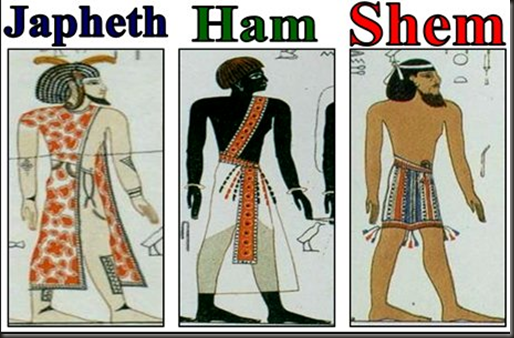
I don't present this image as historically accurate.  Frankly it doesn't make biological sense, but it illustrates the traditional perspective.

One of the most diabolical lies read into history and Christianity is the  “Curse of Ham.”

Based on willfully deceptive readings of Genesis chapters 9 & 10, slave traders created a doctrine in which it was God’s will for Africans and their descendants to be enslaved.   

Outside of and inside of the Black community the “Curse of Ham” doctrine still persists.  White preachers still whisper it as a call to save the pitiful Africans. Based on it Black activists try to rewrite our national genealogies.

So let’s just all take a deep breath, and let the Bible speak.

Genesis 9: 20-25, says that after the Great Flood, Noah got drunk and passed out---naked.  (In Noah’s defense, given the stress of watching everybody on the planet die from drowning while being solely responsible for the survival of the human race in the midst of catastrophic climate conditions never before seen on the planet---- getting sloppy drunk once is a little understandable.)

Ham, Noah’s middle child, made fun of his dad to his two brothers.  When Noah woke up and heard about it, he was pissed!  Then he said: “Cursed be Canaan.  A servant of servants he shall be to his brethren.” (Genesis 9: 25)

That’s the curse part.

But do you notice a problem?

An identity problem?

Noah didn’t curse Ham.  Noah cursed CANAAN.

It could have been that Canaan was Ham’s other name, a nickname his dad used when particularly mad--- except that the author of Genesis went out of his way to call Noah’s middle son, Ham, the father of Canaan  (Genesis 9: 22).  Kinda like God wanted to make sure we didn’t confuse Noah’s middle son with Noah’s grandson.

Biblically-speaking, there is no “Curse of Ham.” There is a Curse of Canaan.

Genesis 10:6 says that Ham had 4 sons: Cush, Mizraim [also known as Egypt], Put, and Canaan.

The patriarchs were cousins, and as humanity multiplied and spread, they intermarried and interconnected even more. Nobody today is just one ethnic thing.  But, there are some clear political lines of descent.

Canaan became the patriarch of the Canaanite nations.  You know, all the –ites that Israel displaced when they came into the Promised Land (Genesis 10: 15-19).   The descendants of Cush founded Babylon, Assyria, and the empires of the African interior  (Genesis 10: 7-12).   The African nations most exploited by the Trans-Atlantic slave trade are linked to the line of Cush.  Black Americans are (mainly) descendants of Cush.

So, class, let’s review.

Who made Noah mad?  Ham.
Whom did Noah curse?  Canaan, Ham’s son.
Are African-Americans genealogically linked to Ham? Yes.  Yes, we are.
Are African-Americans from the line of Canaanite nations,  the cursed son of Ham?  NOPE.

God never cursed Black people. Everybody who ever said the enslavement and oppression of Africans and Blacks was God’s will was A LYING LIAR TELLING LIES.


Why would Noah curse the grandson instead of the son who shamed him?  

Noah couldn’t curse Ham.  He didn’t have the authority.

After the Flood waters subsided, God blessed Noah and his sons, and said to them: “Be fruitful and multiply, and fill the earth. (Genesis 9: 1)

Noah’s sons, including Ham, were direct and equal parties with Noah in God’s post-flood covenant.  

Then God spoke to Noah and to his sons with him, saying: “And as for Me, behold, I establish My covenant with you and with your descendants after you (Genesis 9: 8, 9)

God Himself had personally blessed Ham, and what God blesses no man can curse.

Mad and hungover as Noah was, he couldn’t override God.

There is no Curse on Ham.

O.K., think about it historically.

Racists tried to make the “curse” apply to central and southern Africa, but Ham was also the forefather of Egypt, Babylon, Assyria, and other great empires in the region.  There’s no Genesis curse on them.  Revelations, sure; but not Genesis.

And let’s put the last 500 years of African degradation in perspective. That’s 5 centuries out of 10,000 years, or more.  Depending on whose archaeology you believe, human civilization might be 200,000 years old or 3.4 million years old.  Over the vast majority of that span, Africa and the Middle East where the pinnacle of human achievement.  Ham’s kids did pretty darn well for themselves.

Granddaddy Noah’s curse on Canaan was played out when Israel invaded the Promised Land. 

You shall utterly destroy them: the Hittite and the Amorite and the Canaanite and the Perizzite and the Hivite and the Jebusite, just as the Lord your God has commanded you (Deuteronomy 20: 17)

But even then, while honoring a patriarch’s promise, God exercised His sovereign mercy.

Remember Rahab.  (Joshua chapter 2)

Jesus, the greatest of all Noah’s descendants, was descended from Rahab, a Canaanite hooker.  (Matthew 1: 5-16)

Yes, I just said that Jesus is also a descendant of Ham.

What God blesses no man can curse.

Perhaps the saddest legacy of the so-called curse of Ham is the self-hate it generated.    Generations of African descendants subconsciously absorbed the lie of Ham’s curse.  Some responded with their own lies in self-defense.  They tried to rewrite Africa into an ethnically Hebrew continent.  The tried to cast off Ham as an ancestor and reframe our history as that of Israelites. 

You don’t have to do all of that.

We don’t have to be someone other than who we are.  The descendants of Africans are the descendants of Ham.  We are not cursed.  As far as Noah was concerned, we were un-cursable.

Anyway, that’s what the Bible says.

---Anderson T. Graves II   is a writer, community organizer and consultant for education, ministry, and rural leadership development.

Rev. Anderson T. Graves II is pastor of Miles Chapel CME Church in Fairfield, Alabama;  executive director of the Substance Abuse Youth Networking Organization (SAYNO);  and director of rural leadership development for the National Institute for Human Development (NIHD).

Subscribe to my personal blog  www.andersontgraves.blogspot.com .

Email atgravestwo2@aol.com
Follow me on twitter @AndersonTGraves 

You can help support this ministry with a donation to Miles Chapel CME Church.

You can help support Rev. Graves’ work by visiting his personal blog and clicking the DONATE button on the right-hand sidebar.

Support by check or money order may be mailed to 
Miles Chapel CME Church
P O Box 132
Fairfield, Al 35064

DANGER IN THE DESCENT

Blogging Genesis, 1st of 2 reblogs for Genesis chapter 10.

In 2008, a research team from Massachusetts General Hospital performed a comprehensive investigation into specifically why so many climbers die on Mt. Everest. They found that most people who lose their lives on the highest mountain in the world do not actually die climbing up to the peak. They die coming back down.

The Biblical patriarch Noah built the ark. In one of the greatest acts of faith in history, Noah constructed a great wooden ship and saved humanity and the genetic ancestors of all land animals. All this is recorded in Genesis chapters 6-8.

In Genesis 9:21, Noah got drunk.

Sloppy drunk.

Sloppy-took-all-his-clothes-off-and-passed-out-naked drunk.

The hero of humanity shamed himself before his family. Noah’s youngest son Ham made fun of him, and in anger (and no doubt embarrassment) Noah took out his frustration on Ham’s son.  Noah cursed Canaan, providing for Canaan’s descendants to eventually form the pagan nations that rejected God and fought the Israelites (Genesis 10: 15-18).  Noah’s shame led to the generational animosity between Israelites and Canaanites that plagued the Middle East for centuries. 

All because Noah got sloppy drunk.

How could a noble, holy man like Noah let himself fall into such a situation?

He was coming down from a peak.

The high point of Noah’s life was the ark. Comparing Genesis 7: 11 and 8: 14, we realize that Noah and his family were inside the ark for over a year. That year is added to the time it took Noah to build the thing.

Think about the intense focus, planning, and constant effort all of this took. Once the Flood came and the ark was afloat, Noah literally became the head of humanity, the patriarch of the planet. Inside the ark he had to attend to the animals, see to the distribution of provisions, settle disputes, make decisions. There was constant activity.

Until the waters receded.

Then, Noah found himself again on dry land, but it was not land he recognized. The face of the world had changed. Sure, he named his landing site Mt. Ararat, but he couldn’t know relative to the pre-Flood world how far he’d actually floated. On dry land, the animals disbursed and started doing what animals do---without Noah’s direction. On dry land, his sons would have begun talking about building their own houses and going off with their wives to lead their own families. On dry land, without the constant work of the ark Noah would have had time to stop and reflect on the fact that every old friend, relative, and acquaintance he had known was dead.

During the crisis of the flood Noah had been strong. Doing the work of the ark Noah had been steadfast. But when the adrenaline ebbed the strain of the regular routine of just living was too much.

Noah couldn’t handle coming down from the peak.

For some of us, crises are easy. We’re ready to put in extraordinary effort, to rise to tough challenges, to deliver excellence under pressure. We like to push ourselves to conquer new summits of performance. Satan won’t trip us in the middle of a crisis because we are at our spiritual and personal best in tough times.

We, however, are at our weakest after the peak. When extraordinary demands give way to ordinary days we have to be extra careful of our spiritual lives.

Satan will come at us then. He’ll assault our peace and tempt us to escape into whatever is our favorite or habitual distraction. For Noah it was the wine bottle. For others it may be food or sex or conflict or whatever.

If we let Satan trip us after the peak, we may find ourselves doing things that put us to shame before our families and cause problems that linger for years.

Guard yourself after the peaks. Remind your support team to continue & even to intensify prayer for you after the big event is over.

Don’t let yourself be destroyed on the descent from the mountain.

2 Corinthians 2: 11 …for we are not ignorant of [Satan’s] devices.


---Anderson T. Graves II   is a writer, community organizer and consultant for education, ministry, and rural leadership development.

Rev. Anderson T. Graves II is pastor of Miles Chapel CME Church in Fairfield, Alabama;  executive director of the Substance Abuse Youth Networking Organization (SAYNO);  and director of rural leadership development for the National Institute for Human Development (NIHD).

Subscribe to my personal blog  www.andersontgraves.blogspot.com .

Email atgravestwo2@aol.com
Follow me on twitter @AndersonTGraves  #Awordtothewise 

You can help support this ministry with a donation to Miles Chapel CME Church.

You can help support Rev. Graves’ work by visiting his personal blog and clicking the DONATE button on the right-hand sidebar.

Support by check or money order may be mailed to 
Miles Chapel CME Church
P O Box 132
Fairfield, Al 35064

Saturday, December 17, 2016

EVERYTHING UNDER THE RAINBOW


The most mixed up gospel song ever sung, “Mary Don’t You Weep,” includes the verse:
God gave Noah the rainbow sign
It won’t be water, but fire next time

The lyric refers to the covenant that God re-established with mankind after the Great Flood. In Genesis 9:11-17, God declared that the refraction of light into its component wavelengths of visible colors following atmospheric precipitation, i.e. rainbows, would be the sign for perpetual generations (Genesis 9:12) that God wouldn’t send another globally fatal flood.

The details of the deal are called the Noahic covenant, but that name is a little misleading.  Noah and his descendants  weren’t the only parties to the contract. 

“And as for Me, behold, I establish My covenant with you and with your descendants after you and with every living creature that is with you . . . (Genesis 9:9-10)

The next clause of the covenant  specifically identifies living creature as the birds, the cattle, and every beast of the earth with you, of all that go out of the ark: every beast of the earth. (Genesis 9:10)

The rainbows that recall God’s promise to mankind also reaffirm Nature’s status in the covenant.  

I set My rainbow in the cloud, and it shall be for the sign of the covenant between Me and the earth(Genesis 9:13)

In the Noahic covenant, Nature is an equal partner with humanity.   In God’s eyes, the Earth isn’t just where humans beings get our food and stuff.   Nature, Earth’s animals and ecosystems, i.e. “the environment,” matters to God (which makes sense, considering God invested 5 ½ of 6 Creation days building it). 

The earth is the Lord’s, and all its fullness, the world and those who dwell therein. (Psalm 24:1)

Don’t forget that the God’s plan of salvation isn’t just a plan to save the souls of people; it is also God’s plan to save the planet --- from us.

From our physically destructive conflicts.
In that day I will make a covenant for them with the beasts of the field, with the birds of the air, and with the creeping things of the ground.
Bow and sword of battle I will shatter from the earth, to make them lie down safely. (Hosea 2:18)

From our general sinfulness.
For the earnest expectation of the creation eagerly waits for the revealing of the sons of God. . . because the creation itself also will be delivered from the bondage of corruption into the glorious liberty of the children of God.  (Romans 8: 19-21)

Under a 3-way agreement like the Noahic covenant, each party is responsible to the other two.  God gives us the privilege of dominion as the alpha predators of the planet, but we are uniquely predators who also act as stewards of that which we dominate.

We get that right only SOME of the time.  We consume vegetation, but we cultivate more than we eat.  We don’t just hunt meat; we also raise and multiply herds of meat animals.  So also, we shouldn’t just drink and breathe and extract natural resources for our needs and desires.  We have a covenantal duty to preserve, return, and replenish what we remove from the Earth.

It is all ours to use and it is equally all ours to manage.  The Noahic covenant of Genesis 9 declares that in the end, God expects a increased return on His people and on His planet.  I mean, if He’d wanted the place wrecked and desolate, He would’ve left it like that Himself after the Flood.

---Anderson T. Graves II   is a writer, community organizer and consultant for education, ministry, and rural leadership development.

Rev. Anderson T. Graves II is pastor of Miles Chapel CME Church in Fairfield, Alabama;  executive director of the Substance Abuse Youth Networking Organization (SAYNO);  and director of rural leadership development for the National Institute for Human Development (NIHD).

Subscribe to my personal blog  www.andersontgraves.blogspot.com .

Email atgravestwo2@aol.com
Follow me on twitter @AndersonTGraves  #Awordtothewise 

You can help support this ministry with a donation to Miles Chapel CME Church.

You can help support Rev. Graves’ work by visiting his personal blog and clicking the DONATE button on the right-hand sidebar.

Support by check or money order may be mailed to 
Miles Chapel CME Church
P O Box 132
Fairfield, Al 35064

Sunday, December 11, 2016

A GREAT GIFT IN UGLY WRAPPING

In the Christmas season we wrap gifts or pay for it to be done.  Some of us are as careful of the way we cover the presents as we are of what we put inside. As an 80’s tv father once said, “It’s all about the presentation.”  But what if it isn’t.  What if someone offered you the greatest gift you’d ever receive, but they placed the gift in the ugliest, most unappealing possible place and circumstances.  That actually happened for all of us about 2,000 years ago.  Take a new, and possibly disturbing, look at the nativity. 

The title of the message is A GREAT GIFT IN UGLY WRAPPING.


Listen well.

If you can’t get the audio on your device, visit the main podcast page at http://revandersongraves.podomatic.com/

---Anderson T. Graves II   is a writer, community organizer and consultant for education, ministry, and rural leadership development.

Rev. Anderson T. Graves II is pastor of Miles Chapel CME Church in Fairfield, Alabama;  executive director of the Substance Abuse Youth Networking Organization (SAYNO);  and director of rural leadership development for the National Institute for Human Development (NIHD).

Subscribe to my personal blog  www.andersontgraves.blogspot.com .

Email atgravestwo2@aol.com
Follow me on twitter @AndersonTGraves  #Awordtothewise 

You can help support this ministry with a donation to Miles Chapel CME Church.

You can help support Rev. Graves’ work by visiting his personal blog and clicking the DONATE button on the right-hand sidebar.

Support by check or money order may be mailed to 
Miles Chapel CME Church
P O Box 132
Fairfield, Al 35064

#Awordtothewise, Jesus, Joseph, Mary, star, shepherds, angels, gift, presentation, Bethlehem, stable, inn, nativity, swaddling, manger, Christ, Christmas, cosby, present, wrapping, wrapped


Saturday, December 10, 2016

WISE MEN GO ANOTHER WAY

What should a church or a Christian do when their best, most logical, and wisest choice turns out to be wrong?  How does a believer choose among all the options and advice that seem good and godly and wise --- at the time? The answers can be found a Christmas story about wise men trying to find their way.  Originally delivered at Evergreen Baptist Church in Birmingham, the title of this message is  WISE MEN GO ANOTHER WAY.


Listen well.

If you can’t get the audio on your device, visit the main podcast page at http://revandersongraves.podomatic.com/

---Anderson T. Graves II   is a writer, community organizer and consultant for education, ministry, and rural leadership development.

Rev. Anderson T. Graves II is pastor of Miles Chapel CME Church in Fairfield, Alabama;  executive director of the Substance Abuse Youth Networking Organization (SAYNO);  and director of rural leadership development for the National Institute for Human Development (NIHD).

Subscribe to my personal blog  www.andersontgraves.blogspot.com .

Email atgravestwo2@aol.com
Follow me on twitter @AndersonTGraves  #Awordtothewise 

You can help support this ministry with a donation to Miles Chapel CME Church.

You can help support Rev. Graves’ work by visiting his personal blog and clicking the DONATE button on the right-hand sidebar.

Support by check or money order may be mailed to 
Miles Chapel CME Church
P O Box 132
Fairfield, Al 35064

#Awordtothewise, Jesus, magi, wise men, Joseph, Herod, Mary, star, Jerusalem, king, Jews, another way, direction, goal, destination, purpose, anointing, decision, choice, Bethlehem, Egypt, gold, frankincense, myrrh


Thursday, December 8, 2016

LOGICAL INJUSTICE


So, there’s this thing I’ve heard in church for decades ---- well, one of several things ---- that just never quite sounded right to me.  When my preachers and Sunday school teachers talked about Jesus’ trial and crucifixion they explained that Jesus’ Jewish accusers brought Him to Pilate Jewish courts didn’t have the authority to issue the death penalty.  That sounded logical.  The Jews were a conquered people living under Roman occupation as second-class citizens in their own land.  It made sense that Rome would limit the legal power of Jewish courts.  My teachers even had a Scripture reference.  

In John 18:31 Pilate tried to remand Jesus’ case back to the Jewish Councils.   He said, “You take Him and judge Him according to your law.”
Therefore the Jews said to him, “It is not lawful for us to put anyone to death.”

The Jews in this verse were experts on the Law. They said what the law said, so that must be right.

Right?

Do you remember the story of the woman they caught committing adultery and dragged before Jesus while He was teaching in the Temple.  Yes?  No?  Anyway,  it’s in John 8.

John 8:4-5  they said to Him, “Teacher, this woman was caught in adultery, in the very act. Now Moses, in the law, commanded us that such should be stoned.

Stoned.  As in, “to death.”  They didn’t need Pilate’s permission then.

And just to be clear that this wasn’t some gender-specific exception.  Go down a little further to John 8:59  and John 10:31 because in those passages, they tried to stone Jesus.  As in, “to death.”  Just a few months after the crucifixion, Acts 7 states that the same religious-political authority that told Pilate they didn’t have the legal authority to put anyone to death exercised their legal authority to stone Stephen to death for preaching Jesus.

So yeah, they said that they couldn’t carry out the death penalty, but they could.

In the late night and early morning between the Last Supper and the Crucifixion, two separate trials, presided over by the high priest emeritus Annas and reigning high priest Caiaphas, had both found Jesus guilty of criminal blasphemy.   And they all condemned Him to be deserving of death (Mark 14:64).  So why didn’t they carry out the sentence?  They had the authority to hit Jesus in the head with rocks until He died.  They could have thrown Him off a cliff on to the stones below (Luke 4:28-30). They had won.

Why did the winning prosecutors appeal their own case to Pilate?

Because --- and this is the puzzle piece that I hadn’t previously connected to the crucifixion story --- because of Deuteronomy 17.

The rulings of the Sanhedrin Councils were based on the Mosaic law like American court cases are based on the Constitution and state criminal codes.

Whoever is deserving of death shall be put to death on the testimony of two or three witnesses; he shall not be put to death on the testimony of one witness.
The hands of the witnesses shall be the first against him to put him to death, and afterward the hands of all the people. So you shall put away the evil from among you. (Deuteronomy 17: 6-7)
Every Jewish death penalty case required the testimony of multiple eye witnesses.  The witnesses in a capital case had to participate in carrying out the death sentence.  In fact  the  hands of the witnesses shall be the first against him to put him to death.

Witnesses had to be the first to cast stones.


You couldn’t testify that, for example, a man had blasphemed Moses and the Temple, falsely claimed to be the Son of God and threatened to destroy the Temple and overturn the scriptures and then just go home.  You had to go out in public and by casting the first stone  declare that you had personally seen and heard everything in your sworn testimony.

Oh, and another statue of the Mosaic Law stated that
If a false witness rises against any man to testify against him of wrongdoing, . . . then you shall do to him as he thought to have done to his brother; so you shall put away the evil from among you.. .  Your eye shall not pity: life shall be for life, eye for eye, tooth for tooth, hand for hand, foot for foot. (Deuteronomy 19:16, 19, 21)

If the community found out you had lied in a capital blasphemy case, they were required to stone you.  As in, “to death.”

. .  . many bore false witness against Him, but their testimonies did not agree (Mark 14:56).

None of the witnesses were willing to risk their lives on stories they couldn’t even keep straight among themselves, especially when just a few days earlier, on Palm Sunday, all of Jerusalem had been shouting “Hosanna” and praising Jesus as “He who comes in the name of the Lord” (John 12:13).

Even though the high priests had double-convictions against Jesus, they couldn’t carry out the sentence because nobody was willing to cast the first stone.

And that is why they took Jesus to Pilate. 

It’s like when a local district attorney  forces through a conviction on shaky evidence.  He asks for and gets the death penalty but he knows his case won’t hold up under the scrutiny of a death penalty appeal so he kicks the defendant over to the feds.  In federal court they change the charge to something terrorism-related and let politics run its crooked course.

Jesus was arrested for blashphemy against Moses.  He was executed for treason against Caesar.

Pilate never found Jesus guilty.  At least twice the Roman governor declared, “I find no fault in Him.” (John 18:38; 19:4). He gave the order for Crucifixion anyway. 

Politics.

The authorities who brought Jesus before Pilate claimed to be settling a legal technicality.  But they were really using Jesus to enforce their personal and political agenda.  They claimed to be following the Law, but the letter and spirit of their Laws was against them. 

My old teachers assumed that since the exchange in John 18:31 took place in a legal setting that it was an accurate explanation of the law.  It wasn’t.  Legal authorities lied about what the Law said.  The result was an innocent man executed for crimes that had absolutely nothing to do with Him.

Four Points:
1)  Legal injustice happens.  Even under a legal system derived from the tenets of Scripture, this kind of injustice actually happens. Stop saying that it doesn’t.

2) Injustice happens to the innocent.  No one was more innocent than Jesus.

3)  Injustice didn’t just start happening.  The same pattern of injustice that led to Jesus’ crucifixion are in play today in America, but it’s not unique to our times or to America’s particular racial and social history. 

4)  The fact that injustice happens in no excuse for letting injustice happen. And though it was prophesied to happen, it doesn’t diminish that sinfulness of those who participated in and kept silent in the face of the unjust legal activity.
It is impossible that no offenses should come, but woe to him through whom they do come! (Luke 17:31)
P.S.  Just because you don’t give the order or issue the verdict doesn’t mean you aren’t part of the problem.   As Jesus told Judge Pilate, “You could have no power at all against Me unless it had been given you from above. Therefore the one who delivered Me to you has the greater sin.”

Maybe you heard something different.  Maybe you heard that judges are always fair and that if people go to jail they deserve it.  Maybe you heard the reasons why people who kill unarmed people go free.  Maybe you heard those reasons from someone in legal authority.  I’m sure it sounded logical. 

But you have access to a Bible, don’t you.  A complete Bible. Read it.  Scrutinize what you heard against the whole witness of Scripture.  Pray and think.


Pray and think.