Search This Blog

Monday, February 16, 2015

THE BIPOLAR PROPHET


In the final chapter of his epistle, the author of the book of James talked about the power of  prayer.   

The effective, fervent prayer of a righteous man avails much.  (James 5: 16)

For the righteous man who best exemplified effective and fervent prayer, James chose the Old Testament prophet Elijah.  But, James’ description of Elijah didn’t concentrate on Elijah’s effectiveness, his fervency, or his righteousness.   The focus was on Elijah’s ISSUES.

Elijah was a man with a nature like ours, and he prayed earnestly that it would not rain; and it did not rain on the land for three years and six months. And he prayed again, and the heaven gave rain, and the earth produced its fruit. (James 5: 16-18)

Like all of us, the Elijah had issues.  Elijah’s specific issue was that the prophet was bipolar.

The Mayo Clinic website provides the following definition:
Bipolar disorder, formerly called manic depression, causes extreme mood swings that include emotional highs (mania or hypomania) and lows (depression). When you become depressed, you may feel sad or hopeless and lose interest or pleasure in most activities. When your mood shifts in the other direction, you may feel euphoric and full of energy. Mood shifts may occur only a few times a year or as often as several times a week.

Now read back through  1 Kings 18.

Elijah got all up in King Ahab’s face and said, “I’m not the one causing trouble in Israel. YOU’RE the one causing trouble in Israel!  YOU. YOUR WIFE. YO’ MAMA. AND EVERYBODY IN YO’ HOUSE!” (1 Kings 18: 16-18, “slightly” paraphrased)

In verses 19-24,  Elijah challenged 850 pagan prophets to a winner-take-all pray-off in front of the whole country.

Elijah prayed down fire from Heaven.

He incited a violent uprising against the pagan priests favored by King Ahab and Queen Jezebel. (verses 36-40)
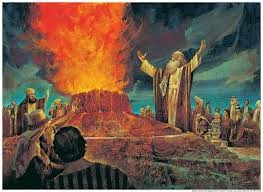

Afterwards, Elijah told the king, “Bro, you better grab a snack cause I’m bout ta’ bring the rain.” (verse 41, paraphrased)

And then, after giving Ahab’s royal chariot a head start, Elijah outran the chariot--- on foot!

So he said, “Go up, say to Ahab, ‘Prepare your chariot, and go down before the rain stops you.’ ” … Then the hand of the Lord came upon Elijah; and he girded up his loins and ran ahead of Ahab to the entrance of Jezreel.  (1 Kings 18: 44-46)

That’s about 30 miles by Route 66 in Israel.  On foot!

Wow! Just wow!  1 Kings 18 was the greatest emotional high of Elijah’s prophetic career.

And the opening verses of the next chapter, immediately after all of this, is Elijah running away, all the way out of the country, dropping off his assistant, and going off into the woods to sit under a tree and think suicidal thoughts.  (1 Kings 19: 3-4)

Elijah’s suicidal depression was triggered when Queen Jezebel threatened his life (verses 1-2)--- which, given Jezebel’s well-established record of systematically killing off all the Jewish prophets she could find, shouldn’t have been a shock to Elijah, especially after Elijah had 400 of her favorite pagans killed.

Elijah’s feelings were not rationally proportionate to the situation.  But, depression isn’t proportionate or rational. Depression is all-consuming.

By fleeing to Judah and then leaving his servant in Beersheba, Elijah isolated himself.

An angel made Elijah get up and eat only to come back the and find him again still curled up alone and not eating. (verses 5-7)

Even, after 40 days, when Elijah had made his way to Mt. Horeb, the mountain of the Lord, where God was going to speak to him, the prophet was still in a deep, dark emotional place.

Twice, God asked Elijah, “What are you doing?”

Twice Elijah, gave the same pitiful answer:
“I have been very zealous for the Lord God of hosts; for the children of Israel have forsaken Your covenant, torn down Your altars, and killed Your prophets with the sword. I alone am left; and they seek to take my life.” (1 Kings 19: 10)

From hyper, chariot-racing, rain-bringing, fire-starting champion, to suicidal, emo, repeating-himself basketcase.

Elijah was bipolar.

Point?

1)      Mental illness is not a sin.  Elijah was bipolar, but he was also the New Testament example of a righteous man whose prayers God heard and answered.

2)      Your “issues” don’t have to keep you away from God.  Elijah prayed while he was suicidal, and God answered. 

3)      The absence of an immediate answer doesn’t mean the absence of an answer.  Elijah was out in the wilderness, under trees, and in caves for over 40 days before God spoke to him in the still small voice that showed the way out.

4)      Your issues don’t change your calling.  After 1 Kings 18 & 19, Elijah was still bipolar, and he was still the great prophet of Israel.  The Lord sent Elijah back to do the exact same work he had run away from.

The LORD said to him, "Go back the way you came. (1 Kings 19: 15, NIV)

Dealing with your mental issues will make your ministry even stronger.  After this episode, Elijah went on to anoint two kings (different countries) and his own successor, whom Elijah personally trained and left with a double portion of spiritual power. (2 Kings 2)

5)      Your “anointing” doesn’t fix your mental illness.  I repeat: You may be genuinely called, anointed, and gifted for a great spiritual work; and still need outside help with your mental health issues.


In 1 Kings 19, God sent a mighty whirlwind, a great earthquake, and a consuming fire; but after all those miracles Elijah still had the same depression-driven  answer to the question: What are you doing here? (1 Kings 19: 11-13)

Which brings us to the final point.
6)      If you are a man or woman with issues like Elijah, or any other mental health issue, keep praying mightily for others, but also GET YOURSELF SOME HELP.

The still small voice of God commanded Elijah to stop isolating himself.  God told Elijah to get help from Jehu of Israel, Hazael of Syria, and Elisha of Abel Meholah; and God referred Elijah to the 7,000 member sons of the prophets support group.  (verses 16-18)

Of all the mighty men and women of prayer in the Old Testament, the Holy Spirit told James to write about Elijah.  That wasn’t an accident. 

Learn the lessons of the bipolar prophet. 

This post expands on my notes for the sermon “Plans & Issues.”  Click here to listen to the complete message.

---Anderson T. Graves II   is a writer, community organizer and consultant for education, ministry, and rural leadership development.

Rev. Anderson T. Graves II is pastor of Miles Chapel CME Church in Fairfield, Alabama;  executive director of the Substance Abuse Youth Networking Organization (SAYNO);  and director of rural leadership development for the National Institute for Human Development (NIHD).

Subscribe to my personal blog  www.andersontgraves.blogspot.com .

Email atgravestwo2@aol.com
Follow me on twitter @AndersonTGraves 

You can help support this ministry with a donation to Miles Chapel CME Church.

You can help support Rev. Graves’ work by visiting his personal blog and clicking the DONATE button on the right-hand sidebar.

Support by check or money order may be mailed to 
Miles Chapel CME Church
P O Box 132

Fairfield, Al 35064

GOD'S AFRICAN CONNECTION


Eurocentric historians have worked hard to portray Black Africa as perpetually uncivilized and unimportant to world history, including Biblical history.  Part of that effort included  dividing Egyptian civilizations from “Black” Africa, so that the well-known Biblical references to Egypt wouldn’t count as references to Black people.  Implicitly and explicitly, I was taught that outside of Egypt, ancient Africa was just a bunch of disorganized, insignificant, tribal villages.

Well that’s not what the Bible says.

The Bible says that Egypt was totally integrated into the larger African culture. 

Around 926 B.C., during the reign of Rehoboam, king of the Judah, the Bible says that Shishak king of Egypt came up against Jerusalem… with twelve hundred chariots, sixty thousand horsemen, and people without number who came with him out of Egypt— the Lubim, and the Sukkiim, and the Ethiopians. (2 Chronicles 12: 1, 2)

Egyptologist identify Shishak as Pharaoh Sheshonk I, who  left behind records of a military campaign into Canaan.  So, we don’t have to argue about historical support for this passage.  It happened. 

The invasion force in 2 Chronicles 12 was an alliance of Egyptians, Lubim, Sukkiim, and Ethiopians. 

Lubim were Libyans, a central north African nation. Sukkiim refers to desert tribes from the Saharan territory of ancient Libya.  Ethiopia covered territory in central and west Africa.   

17th Century British Map of Africa
Remember that the modern, post-colonial borders of Libya, Egypt, and Ethiopia are nothing like their ancient boundaries.  As the map shows, as late as the 17th century, Europeans faced expansive African states, not tiny, disorganized, uncivilized tribal savages.

In fact, you can’t think of ancient Egypt, Libya, and Ethiopia as “countries.” Think of them as regions and empires.  The army in 2 Chronicles 12 consisted of peoples from the regions of northern, eastern, western, and central Africa. 

The Bible says that Black people were always a positive part of God’s plans.

15 centuries before the Islam came into existence,  Black people marched into Judah.

And God had sent them.  

When Rehoboam had established the kingdom and had strengthened himself, that he forsook the law of the Lord, and all Israel along with him….Shishak king of Egypt came up against Jerusalem, because they had transgressed against the Lord (2 Chronicles 12: 1, 2)

When King Rehoboam saw the power of Black army arrayed against his new kingdom, he started praying.  God responded: “…My wrath shall not be poured out on Jerusalem by the hand of Shishak. Nevertheless they will be his servants, that they may distinguish My service from the service of the kingdoms of the nations.”  (2 Chronicles 12: 7, 8)

That’s right. An African army conquered Judah.

So Shishak king of Egypt came up against Jerusalem, and took away the treasures of the house of the Lord and the treasures of the king’s house; he took everything. He also carried away the gold shields which Solomon had made (2 Chronicles 12: 9)

The Bible says that Egypt wasn’t the only African empire that influenced Biblical history.

Notice that that the human authors of the Old Testament clearly understood that Egypt was one of many empires in region we know as Africa, and they understood from interaction and experience that even separate nations were formidable civilizations.  

A generation after the African conquest of Judah, Ethiopia had overtaken Egypt as the dominant power.  2 Chronicles 2: 9 says Then Zerah the Ethiopian came out against them with an army of a million men and three hundred chariots, and he came to Mareshah.

A million soldiers.  Black soldiers.  In the 9th century.  B.C.

The Bible says that not only were Black empires important in God’s plan, so were individual Black persons. 

When the prophet Jeremiah was unjustly imprisoned for speaking God’s truth to the power in the Jewish state, an Ethiopian eunuch named Ebed-Melech was the prophet’s only ally.

Ebed-Melech went out of the king’s house and spoke to the king, saying: “My lord the king, these men have done evil in all that they have done to Jeremiah the prophet, whom they have cast into the dungeon, and he is likely to die from hunger in the place where he is. For there is no more bread in the city.”  (Jeremiah 38: 8, 9)

Oh, and before you waive off Ebed-Melech as an insignificant “slave,” remember that his position and personal status in the court of the Jewish king was identical to that of Daniel, and the 3 Hebrew boys who served Nebuchadnezzar the Babylonian. 

To them the chief of the eunuchs gave names: he gave Daniel the name Belteshazzar; to Hananiah, Shadrach; to Mishael, Meshach; and to Azariah, Abed-Nego.  (Daniel 1)

The Bible says that there was a constant African connection.

Dark skinned Ethiopians were so familiar to ancient Jews that they were used as a metaphor in Jewish proverbs.

Can the Ethiopian change his skin or the leopard its spots? (Jeremiah 13: 23)

That’s the ancient version of modern African-American saying:  “The only two things I have to do are stay Black and die.”

In the book of Acts, God made Philip the evangelist go way out of his way to make sure that the gospel went to “Black” Africa. 

Now an angel of the Lord spoke to Philip, saying, “Arise and go toward the south along the road which goes down from Jerusalem to Gaza.” This is desert.  So he arose and went. And behold, a man of Ethiopia, a eunuch of great authority under Candace the queen of the Ethiopians, who had charge of all her treasury, and had come to Jerusalem to worship (Acts 8: 26, 27)

Since at least the days of King Solomon, Ethiopians had practiced Judaism.  The Bible says that while the original apostles were still alive and preaching, Ethiopians of the highest influence and rank were pious and observant Jews. 
The Mosaic law and prophets  were published and read in ancient Africa while ancient Europeans were still worshipping Thor, Odin, and the Druid trees.

So Philip ran to him, and heard him reading the prophet Isaiah (Acts 8: 30)

And, according to the Bible, Black African Jews were among the first generation of converts to Christianity.

So he commanded the chariot to stand still. And both Philip and the eunuch went down into the water, and he baptized him. Now when they came up out of the water, the Spirit of the Lord caught Philip away, so that the eunuch saw him no more; and he went on his way rejoicing. (Acts 8: 38, 39)

Empress Candace’s treasury secretary did not die the only Black African Christian in the first century. 

By 330 A.D., King Ezana the Great made Christianity the official religion of Ethiopia and the Aksumite empire.   Christianity didn’t become the the state church of the Roman Empire until AD 380. 

Because of the Holy Spirit’s intervention in the book of Acts, the Church of Ethiopia is the oldest continuing, organized Christian church on the planet.

That’s not just Black history. That’s history ---if you believe the Bible.

---Anderson T. Graves II   is a writer, community organizer and consultant for education, ministry, and rural leadership development.

Rev. Anderson T. Graves II is pastor of Miles Chapel CME Church in Fairfield, Alabama;  executive director of the Substance Abuse Youth Networking Organization (SAYNO);  and director of rural leadership development for the National Institute for Human Development (NIHD).

Subscribe to my personal blog  www.andersontgraves.blogspot.com .

Email atgravestwo2@aol.com
Follow me on twitter @AndersonTGraves 

You can help support this ministry with a donation to Miles Chapel CME Church.

You can help support Rev. Graves’ work by visiting his personal blog and clicking the DONATE button on the right-hand sidebar.

Support by check or money order may be mailed to 
Miles Chapel CME Church
P O Box 132
Fairfield, Al 35064


Sunday, February 15, 2015

PLANS & ISSUES

God has a plan for each individual’s life.  He also has a plan for the collective life of our culture and people. So then why are conditions in the culture so far from God’s will? The problem isn’t the plan.  The problem is us, specifically our “issues.”

Our issues can destroy a good plan so we have to have a plan for dealing with our issues.  It’ll make sense when you take a new look at the story of Elijah, the bipolar prophet.  The message is called PLANS & ISSUES.


Listen well.

If you can’t get the audio on your device, visit the main podcast page at http://revandersongraves.podomatic.com/

---Anderson T. Graves II   is a writer, community organizer and consultant for education, ministry, and rural leadership development.

Rev. Anderson T. Graves II is pastor of Miles Chapel CME Church in Fairfield, Alabama;  executive director of the Substance Abuse Youth Networking Organization (SAYNO);  and director of rural leadership development for the National Institute for Human Development (NIHD).

Subscribe to my personal blog  www.andersontgraves.blogspot.com .

Email atgravestwo2@aol.com
Follow me on twitter @AndersonTGraves  #Awordtothewise 

You can help support this ministry with a donation to Miles Chapel CME Church.

You can help support Rev. Graves’ work by visiting his personal blog and clicking the DONATE button on the right-hand sidebar.

Support by check or money order may be mailed to 
Miles Chapel CME Church
P O Box 132

Fairfield, Al 35064

Thursday, February 12, 2015

GUNS & GETHSEMANE


Just yesterday, 3 young, law-abiding Muslims were murdered in North Carolina.   Their deaths at the hands of a White shooter will  prompt a new round of debate about guns in America.  Lots of public Christians will speak to the issue.  None of them will say anything new.  They’ll all be reading from the same memos.

So if we could all just take a moment and stop pulling our sermon outlines from the Democratic and Republican talking points of the week and just let the Bible speak, that’d be great.

I present, for your consideration, the words of Jesus from the night before He died. 

Then He said to them, “But now, he who has a money bag, let him take it, and likewise a knapsack; and he who has no sword, let him sell his garment and buy one. (Luke 22: 36)

Jesus did not prohibit His disciples from owning weapons.  It’s not un-Christian to be a gun owner.

So they said, “Lord, look, here are two swords.”
And He said to them, “It is enough.”  (Luke 22:36-38)

Jesus did endorse limits on weapons ownership.  It’s not godlessly communist to license and/or limit how heavily citizens can be armed.

But Jesus said to him, “Judas, are you betraying the Son of Man with a kiss?”
When those around Him saw what was going to happen, they said to Him, “Lord, shall we strike with the sword?”
Then Simon Peter, having a sword, drew it and struck the high priest’s servant, and cut off his right ear.
So Jesus said to Peter,  “Put your sword in its place, for all who take the sword will perish by the sword. Permit even this.” And He touched his ear and healed him. (Luke 22: 48-51; Matthew 26: 52;  John 18: 10-11 combined )

Jesus permitted the right to bear arms and simultaneously condemned the impulse to use them to solve our problems, even when the problem was somebody attacking our Jesus.

So, yeah, you can carry your .40 cal in one pocket and your New Testament in the other without hypocrisy.  But if your first instinct when you feel angry or threatened is to reach for the pistol instead of the Psalms--- then you are waaaay outta line with God.

In the Garden of Gethsemane, Jesus told the disciples that they could not use the very weapons He had just hours before said they had the right to carry.  Then all the disciples forsook Him and fled. (Matthew 26: 56)

And that right there is the problem.

Liberal Christians, conservative Christians, Democrat Christians, and Republican Christians: on guns and pretty much everything else, we’re still running away from the whole truth of what the Bible speaks.  We are regurgitating the same politically polarizing points without considering the possibility that maybe neither side is completely, infallibly right.

Maybe God is an Independent.

Let God be true but every man a liar. (Romans 3:4) 

---Anderson T. Graves II   is a writer, community organizer and consultant for education, ministry, and rural leadership development.

Rev. Anderson T. Graves II is pastor of Miles Chapel CME Church in Fairfield, Alabama;  executive director of the Substance Abuse Youth Networking Organization (SAYNO);  and director of rural leadership development for the National Institute for Human Development (NIHD).

Subscribe to my personal blog  www.andersontgraves.blogspot.com .

Email atgravestwo2@aol.com
Follow me on twitter @AndersonTGraves 

You can help support this ministry with a donation to Miles Chapel CME Church.

You can help support Rev. Graves’ work by visiting his personal blog and clicking the DONATE button on the right-hand sidebar.

Support by check or money order may be mailed to 
Miles Chapel CME Church
P O Box 132

Fairfield, Al 35064

Tuesday, February 10, 2015

This moment in Black History. No! THIS Moment. RIGHT NOW. THIS VERY MOMENT


John the Baptist had zero patience for people who used their history as a crutch, especially when those people were his own people.

In Luke 3, John was at the Jordan River preaching hard on the theme of repentance.  He called the riverside congregation out for their culturally excused sinfulness.

Brood of vipers!

He mocked their public endorsement of his ministry when  they weren’t actually applying his teaching. “What have I been telling you, people?” John asked.

Who warned you to flee from the wrath to come?

John demanded that the people, his people, stop making excuses and start making their lives better by living like he and all the prophets before him had taught.

Therefore bear fruits worthy of repentance

And John, cousin and prophetic predecessor of Jesus, said something that crossed the line.  John invoked the named of their most revered historical figure---- in a negative sense. 

John the Baptist said, do not begin to say to yourselves, “We have Abraham as our father.” For I say to you that God is able to raise up children to Abraham from these stones.

Stop using history as excuse for your sin and stupidity today.  Yes, you are from a line of kings and queens.  You are the historic progeny of great men and great women. You are the descendants of oppressed people whom God delivered from bondage by miraculous intervention.  

O.K.  Now what?

That’s what they did back then.  You do something now.

Therefore bear fruits worthy of repentance

And by the way, your history isn’t all that unique.  God could have chosen any enslaved culture at any point in history and worked the same miracle for them.   That God chose your people is more about God than it is about you.  Cause if God wanted to, He could emancipate the rocks under your feet and make one of them president one day.

Our history is important and relevant.  John didn’t discount the reality of Abraham’s contribution to Jewish history.  The Bible itself is a book of history (and much more) that reiterates the importance of learning the lessons of the past.

Now all these things happened to them as examples, and they were written for our admonition (1 Corinthians 10:11)

But we’ve gotta do more with history than keep walking around in circles talking about what Moses and Martin and them did way back in the day.

The great cloud of historic witnesses are given so we can learn solutions, not just so we can collect reasons for our problems.  Properly learned history supplies methods to confront injustice against our community while simultaneously confronting the sin within our community.

Therefore we also, since we are surrounded by so great a cloud of witnesses, let us  lay aside every weight, and the sin which so easily ensnares us... (Hebrews 12: 1a)

History is meant to provoke action.  .. and let us run with endurance the race that is set before us (Hebrews 12:1b)

History is supposed to lead us to God… looking unto Jesus, the author and finisher of our faith (Hebrews 12:2)

For all of his passion, John the Baptist never claimed to have all the solutions for his people in himself.  But John knew where to look for those solutions.

I indeed baptize you with water; but One mightier than I is coming, whose sandal strap I am not worthy to loose. He will baptize you with the Holy Spirit and fire. (Luke 3:16)

I, Anderson T. Graves II, don’t have all the solutions for my people in myself, but I know where to look for those solutions.

Right now, at this moment in African-American history, we need to sit down with our history books open next to our open Bibles. 

Right now we need learn how God organized and mobilized His people to solve the same problems we face now.  We take Scriptural answers and translate them into the contemporary language of history and social action.   Compare Scripture to history and you’ll see how Moses and Martin and them lifted so many so far so quickly.  With both Biblically and historically sound plans before us, we can look at what we have and ask what John’s people asked.

What shall we do then? (Luke 3:8)

Do that now, right now, at this very moment in Black history.


---Anderson T. Graves II   is a writer, community organizer and consultant for education, ministry, and rural leadership development.

Rev. Anderson T. Graves II is pastor of Miles Chapel CME Church in Fairfield, Alabama;  executive director of the Substance Abuse Youth Networking Organization (SAYNO);  and director of rural leadership development for the National Institute for Human Development (NIHD).

Subscribe to my personal blog  www.andersontgraves.blogspot.com .

Email atgravestwo2@aol.com
Follow me on twitter @AndersonTGraves 

You can help support this ministry with a donation to Miles Chapel CME Church.

You can help support Rev. Graves’ work by visiting his personal blog and clicking the DONATE button on the right-hand sidebar.

Support by check or money order may be mailed to 
Miles Chapel CME Church
P O Box 132
Fairfield, Al 35064


Sunday, February 8, 2015

WHAT IS YOUR NAME

Roots was a novel and television miniseries that defined the modern American image of slavery.  The most iconic scene is Roots posed a powerful question, a question that every one of us today has to answer, a question that not surprisingly the Bible asked first.

Find out what the saga of an American family has in common with the saga of  prophet named Daniel in a message titled WHAT IS YOUR NAME?


Listen well.

If you can’t get the audio on your device, visit the main podcast page at http://revandersongraves.podomatic.com/

---Anderson T. Graves II   is a writer, community organizer and consultant for education, ministry, and rural leadership development.

Rev. Anderson T. Graves II is pastor of Miles Chapel CME Church in Fairfield, Alabama;  executive director of the Substance Abuse Youth Networking Organization (SAYNO);  and director of rural leadership development for the National Institute for Human Development (NIHD).

Subscribe to my personal blog  www.andersontgraves.blogspot.com .

Email atgravestwo2@aol.com
Follow me on twitter @AndersonTGraves  #Awordtothewise 

You can help support this ministry with a donation to Miles Chapel CME Church.

You can help support Rev. Graves’ work by visiting his personal blog and clicking the DONATE button on the right-hand sidebar.

Support by check or money order may be mailed to 
Miles Chapel CME Church
P O Box 132
Fairfield, Al 35064


Friday, February 6, 2015

STALLING CRAZY


Some people have the almost magical ability to turn their bad day into everybody’s bad day.

King Nebuchadnezzar of Babylon was one of those people. 

In Daniel chapter 2, Nebuchadnezzar had a recurring nightmare.   The dreams  were so bad that he started staying awake all night.  On top of that, he either couldn’t remember what happened in the dreams or he didn’t want to tell anybody.  Either way, anxiety and sleep deprivation accumulated until the head of the Babylonian empire just sorta snapped.

He called for all of the the magicians, astrologers, sorcerers, and Chaldeans.  These were the Ivy Leaguers and think tank fellows of the day.

Nebuchadnezzar assembled them as an imperial task force an said, “I have had a dream, and my spirit is anxious to know the dream.” (Daniel 2:2, 3)

They replied, “Tell your servants the dream, and we will give the interpretation.”  (Daniel 2:4)

King Nebuchadnezzer said, “No. You tell ME the dream and what the dream means or I’m gonna chop you up into little pieces, kill your family, burn your house to the ground, and use the pile of smoldering ash as a garbage dump.”  (Daniel 2:5, paraphrased)

Well now EVERYBODY’S having a bad day.

The academics were shocked.  They explained that his request was unreasonable and impossible to comply with. (They would’ve said “with which to comply.”) 

The king accused them of stalling. “I know for certain that you would gain time.”  (verse 8)  

They were  stalling so they could stay and explain very calmly and rationally that it was highly irregular to threaten the leading minds of the nation with death under those conditions.

“There is not a man on earth who can tell the king’s matter; therefore no king, lord, or ruler has ever asked such things of any magician, astrologer, or Chaldean.” (Daniel 2: 10)

And that’s where the “wise men” messed up.  You don’t tell crazy people that they’re acting crazy.  That just makes them act crazier.

Jesus said, “Do not give what is holy to the dogs; nor cast your pearls before swine, lest they trample them under their feet, and turn and tear you in pieces.” (Matthew 7:6)

They called King Nebuchadnezzar unreasonable and he responded by having them killed and ordering the deaths of all their colleagues, co-workers, and employees. 

When you’re dealing with crazy, like everybody’s-about-to-have-a-bad-day crazy, you don’t stall to stay.    You stall to leave.

A young Jewish academic named Daniel worked in the magicians, astrologers, sorcerers, and Chaldeans industry.  When Arioch, the head of the king’s hit squad, came to kill him, Daniel stalled. 

“Why is the decree from the king so urgent?” Daniel asked (verse 15)

Daniel talked his way into an audience with the king.  The king who hadn’t slept in days except to doze off into a nightmare he couldn’t remember, and these guys he pays to know stuff don’t know anything, but, yeah, they paid for that, they’re all gonna pay, bwahahaha, who are you--- that king.

Daniel did NOT tell Nebuchadnezzar to calm down.  He did NOT appeal to Nebuchadnezzar’s sense of mercy or reason.   Daniel stalled so he could leave.

Daniel went in and asked the king to give him time, that he might tell the king the interpretation. (verse 16)

Basically, Daniel said, “Sure I’ll tell you what you dreamed that you don’t even remember.  Sure, but first I need to run home real quick.”

Sometimes, you have to put some distance between you and the crazy, so you can draw closer to God.  Otherwise, you’ll get drawn into their crazy.  Why do you think Jesus kept wandering off from the disciples? (Luke 5: 16)

"Wait here while I go there and pray."

Stall……. to leave. 

If you can’t  physically get away from crazy, you can create mental and spiritual distance.

In August 2013, a mentally troubled man with an AK-47 charged into an Atlanta elementary school and pointed the gun at school clerk Antoinette Tuff.  Physically, she had nowhere to go, but she still managed to stall and leave. 

In her mind, Miss Tuff went back to her pastor’s last sermon when he’d talked about showing compassion for people in grief.   She took the gunman away from his problems and plans by talking about her family and her past struggles with suicide.  In that office, Miss Tuff prayed with the crazy man who had come to kill her.  She responded to the threat in the most Divinely insane way.  She called the man with the gun, “baby,” and she loved him.

The gunman surrendered.  No children were hurt.  (Read more about Antoinette Tuff here.)


Daniel left the king’s audience, went home, and called his friends. Together they prayed until God gave Daniel the impossible answer to the king’s insane request.

Then Daniel went back to minister to crazy King Nebuchadnezzar (cause crazy needs Jesus, too).  

Daniel went to Nebuchadnezzar and said, “There is a God in heaven who reveals secrets, and He has made known to King Nebuchadnezzar what will be in the latter days. Your dream, and the visions of your head upon your bed, were these…” (Daniel 2: 27, 28)

In the end, the king rewarded Daniel, rescinded the execution order, and said, “Truly your God is the God of gods, the Lord of kings, and a revealer of secrets, since you could reveal this secret.” (Daniel 2:47)

You can’t reason with crazy, but God can.  But it takes time, God’s time.  So stall.  Move yourself and the conversation away from crazy to what God wants to say.  Then leave the rest up to God.

---Anderson T. Graves II   is a writer, community organizer and consultant for education, ministry, and rural leadership development.

Rev. Anderson T. Graves II is pastor of Miles Chapel CME Church in Fairfield, Alabama;  executive director of the Substance Abuse Youth Networking Organization (SAYNO);  and director of rural leadership development for the National Institute for Human Development (NIHD).

Subscribe to my personal blog  www.andersontgraves.blogspot.com .

Email atgravestwo2@aol.com
Follow me on twitter @AndersonTGraves 

You can help support this ministry with a donation to Miles Chapel CME Church.

You can help support Rev. Graves’ work by visiting his personal blog and clicking the DONATE button on the right-hand sidebar.

Support by check or money order may be mailed to 
Miles Chapel CME Church
P O Box 132
Fairfield, Al 35064